A Species In Denial
by Jeremy Griffith, published 2003
Reviews
‘I am a professor of psychiatry… [and] I am most enthusiastic about Griffith’s new paradigm and would assure readers not to pass it by. I consider it one of, if not the most important contribution to both understanding and ameliorating The Human Condition thus far written.’
Professor Harry Prosen
Professor Prosen is a leading psychiatrist and former President of the Canadian Psychiatric Association who recently retired as head of the Department of Psychiatry and Behavioural Medicine at the Medical College of Wisconsin. He was responsible for the establishment of two departments of psychiatry, one in Canada and another more recently in the USA. Listed in the 2005-2006 America’s Registry of Outstanding Professionals, he is also psychiatric consultant to the Bonobo Species Preservation Society and is assisting those working with one of the largest collection of captive bonobos in the world at the Milwaukee County Zoo.
Professor Prosen’s review is one of a number of extremely positive reviews that appear on Amazon.com. Additional Amazon reviews appear further down in this section.
A Most Important Contribution to Human Understanding, January 8, 2006
Reviewer: Harry Prosen “therapist in understanding” (Milwaukee, Wisconsin)

I have read A Species In Denial which so excited me that I managed to obtain two other of Jeremy Griffith’s books and read them as well as other of his writings. I also have had personal discussions with significant thinkers and well respected authors in psychiatry, anthropology, physics and philosophy about Griffith’s ideas. I am a professor of psychiatry, working in the field for over 50 years and chaired two departments of psychiatry in two countries. I have been President of a national psychiatric association and have treated many individuals and families in psychotherapy.
I am most enthusiastic about Griffith’s new paradigm and would assure readers not to pass it by. I consider it one of, if not the most important contribution to both understanding and ameliorating The Human Condition thus far written. Many have written about our seemingly desperate situation, as individuals and as a society. This book explains the reasons and confirms, for me at least my studies and work over many years on Empathy in both humans and Bonobo primates (one of the great ape family). It really must be read and understood by all who can acquire and carefully study it.
‘A Species In Denial is a superb book…[that] brings out the truth of a new and wider frontier for humankind, a forward view of a world of humans no longer in naked competition amongst ourselves and with all others.’
Professor John Morton
The late Professor John Morton was Emeritus Professor of Zoology at the University of Auckland, New Zealand; Lay Canon Emeritus of Holy Trinity Cathedral, Auckland; Fellow St. John’s Theological College, Auckland; and author of ‘Man, Science and God’.
Professor Morton was sent an advanced copy of A Species In Denial and subsequently sent the FHA the following review, which appeared in A Species In Denial.
A Species In Denial is a superb book, a marvellous continuation of Jeremy Griffith’s previous work, Beyond The Human Condition. It calls out for deeper thought, both in the biological and spiritual arms of mankind. These are fields of understanding that are drawing closer together. Jeremy’s book brings out the truth of a new and wider frontier for humankind, a forward view of a world of humans no longer in naked competition amongst ourselves and with all others. The fittest and indeed the only humanity able to survive today will be a species evolving and deepening, into a greater harmony with ourselves and with creation at large. We go forward into this new century with a drive for a wider science and a deeper spirituality, to find again for ourselves the place we had come so near to losing: the part that should be ours in a world of loving and understanding.
‘This book is a fascinating stimulus to further work and, above all, spur toward better things. There are not many books offering as much, and few indeed which single out the often neglected prophets of our recent past. It offers so many insights into our divided selves.’
Ronald Conway OAM
The following review by Ronald Conway OAM appeared in the Australian Quarterly Journal of Contemporary Analysis, January-February 2004 edition, p.37. The journal is published six times a year by the Australian Institute of Political Science. It is distributed to about 600 subscribers, including government bodies, the business sector and Australian and overseas university, public and school libraries, including the New York Public Library.
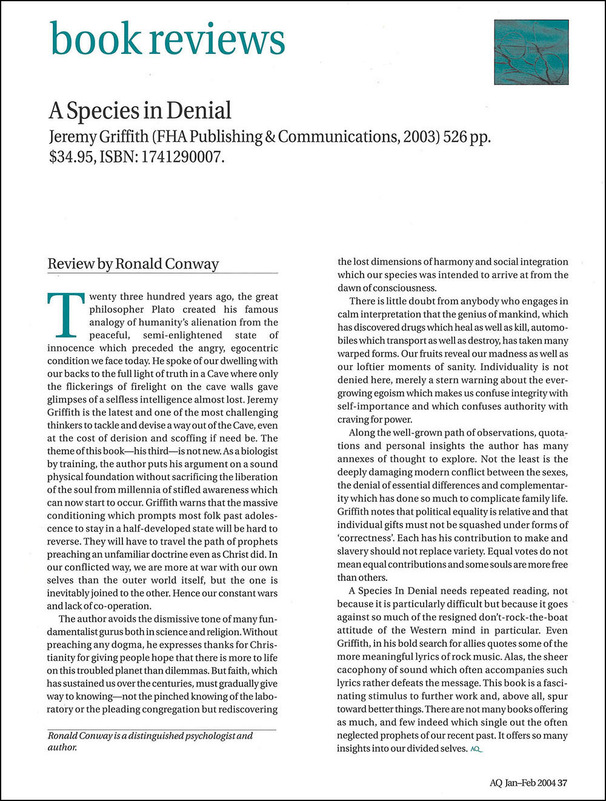
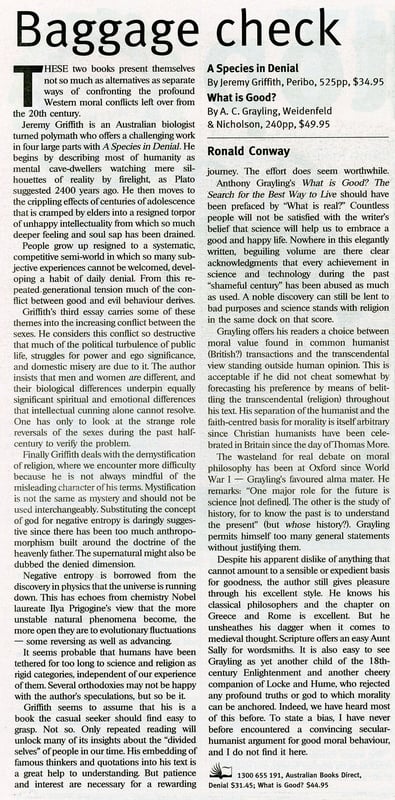
The text in the above article is as follows:
A Species In Denial; Review by Ronald Conway
Twenty three hundred years ago, the great philosopher Plato created his famous analogy of humanity’s alienation from the peaceful, semi-enlightened state of innocence which preceded the angry, egocentric condition we face today. He spoke of our dwelling with our backs to the full light of truth in a Cave where only the flickering’s of firelight on the cave walls gave glimpses of a selfless intelligence almost lost. Jeremy Griffith is the latest and one of the most challenging thinkers to tackle and devise a way out of the Cave, even at the cost of derision and scoffing if need be. The theme of this book—his third—is not new. As a biologist by training, the author puts his argument on a sound physical foundation without sacrificing the liberation of the soul from millennia of stifled awareness which can now start to occur. Griffith warns that the massive conditioning which prompts most folk past adolescence to stay in a half-developed state will be hard to reverse. They will have to travel the path of prophets preaching an unfamiliar doctrine even as Christ did. In our conflicted way, we are more at war with our own selves than the outer world itself, but the one is inevitably joined to the other. Hence our constant wars and lack of co-operation.
The author avoids the dismissive tone of many fundamentalist gurus both in science and religion. Without preaching any dogma, he expresses thanks for Christianity for giving people hope that there is more to life on this troubled planet than dilemmas. But faith, which has sustained us over the centuries, must gradually give way to knowing—not the pinched knowing of the laboratory or the pleading congregation but rediscovering the lost dimensions of harmony and social integration which our species was intended to arrive at from the dawn of consciousness.
There is little doubt from anybody who engages in calm interpretation that the genius of mankind, which has discovered drugs which heal as well as kill, automobiles which transport as well as destroy, has taken many warped forms. Our fruits reveal our madness as well as our loftier moments of sanity. Individuality is not denied here, merely a stern warning about the ever-growing egoism which makes us confuse integrity with self-importance and which confuses authority with craving for power.
Along the well-grown path of observations, quotations and personal insights the author has many annexes of thought to explore. Not the least is the deeply damaging modern conflict between the sexes, the denial of essential differences and complementarity which has done so much to complicate family life. Griffith notes that political equality is relative and that individual gifts must not be squashed under forms of ‘correctness’. Each has his contribution to make and slavery should not replace variety. Equal votes do not mean equal contributions and some souls are more free than others.
A Species In Denial needs repeated reading, not because it is particularly difficult but because it goes against so much of the resigned don’t-rock-the-boat attitude of the Western mind in particular. Even Griffith, in his bold search for allies quotes some of the more meaningful lyrics of rock music. Alas, the sheer cacophony of sound which often accompanies such lyrics rather defeats the message. This book is a fascinating stimulus to further work and, above all, spur toward better things. There are not many books offering as much, and few indeed which single out the often neglected prophets of our recent past. It offers so many insights into our divided selves.
AQ Jan-Feb 2004 37
______________________
Ronald Conway OAM is a distinguished Melbourne clinical psychologist and former academic. He is the author of a number of books on psychology and philosophy, including ‘The Rage for Utopia’ published in 1992 and is a frequently called upon social commentator.
‘A book that confronts the way we think about life…People like [Griffith] used to be drummed out of town by the vicar…Griffith gives the serious reader plenty to ponder…There is never any doubt of the courage of [Griffith’s] stance in writing this book because of his commitment to his fellow man and the future of the planet.’
This review appeared in the Wairarapa News (circulation 23,000), from Wellington, New Zealand, on Wednesday 3 December 2003.
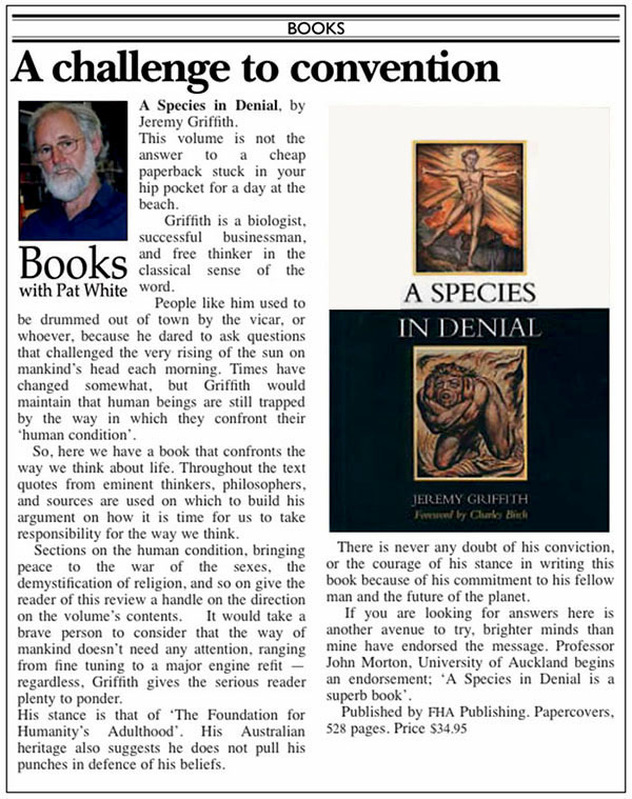
The text in the above article is as follows:
A challenge to convention
A Species in Denial, by Jeremy Griffith.
This volume is not the answer to a cheap paperback stuck in your hip pocket for a day at the beach.
Griffith is a biologist, successful businessman, and free thinker in the classical sense of the word.
People like him used to be drummed out of town by the vicar, or whoever, because he dared to ask questions that challenged the very rising of the sun on mankind’s head each morning. Times have changed somewhat, but Griffith would maintain that human beings are still trapped by the way in which they confront their ‘human condition’.
So, here we have a book that confronts the way we think about life. Throughout the text quotes from eminent thinkers, philosophers, and sources are used on which to build his argument on how it is time for us to take responsibility for the way we think.
Sections on the human condition, bringing peace to the war of the sexes, the demystification of religion, and so on give the reader of this review a handle on the direction on the volume’s contents. It would take a brave person to consider that the way of mankind doesn’t need any attention, ranging from fine tuning to a major engine refit — regardless, Griffith gives the serious reader plenty to ponder.
His stance is that of ‘The Foundation for Humanity’s Adulthood’. His Australian heritage also suggests he does not pull his punches in defence of his beliefs.
There is never any doubt of his conviction, or the courage of his stance in writing this book because of his commitment to his fellow man and the future of the planet.
If you are looking for answers here is another avenue to try, brighter minds than mine have endorsed the message. Professor John Morton, University of Auckland begins an endorsement; ‘A Species in Denial is a superb book’.
Published by FHA Publishing. Papercovers, 528 pages. Price $34.95
‘Those who like philosophy will love reading this.’
The following review appeared (from July 2004) on the ‘Newest Resources’ list on the website for the Council for Christian Nurture & Diocesan Resource Library www.ccn.org.nz, a sector council of the Diocese of Auckland that aims to educate those involved in ministry through resourcing and training.
‘A Species In Denial by Jeremy Griffith #9380. This well reviewed book will challenge its readers. John Morton speaks of the truth it offers as people move forward into a deeper spirituality. Those who like philosophy will love reading this.’
A 10/10 Rating
The following review appeared in the Noosa News (4 Aug. 2003, circulation of 21,000), which serves the popular Noosa coast and hinterland areas of Queensland. It also appeared in the Sunshine Coast Sunday (29 Jun. 2003, circulation of 17,000), which serves the Queensland Sunshine Coast, and the Warwick Daily News in Southern Queensland (3 Jul. 2003, circulation of 5,000).
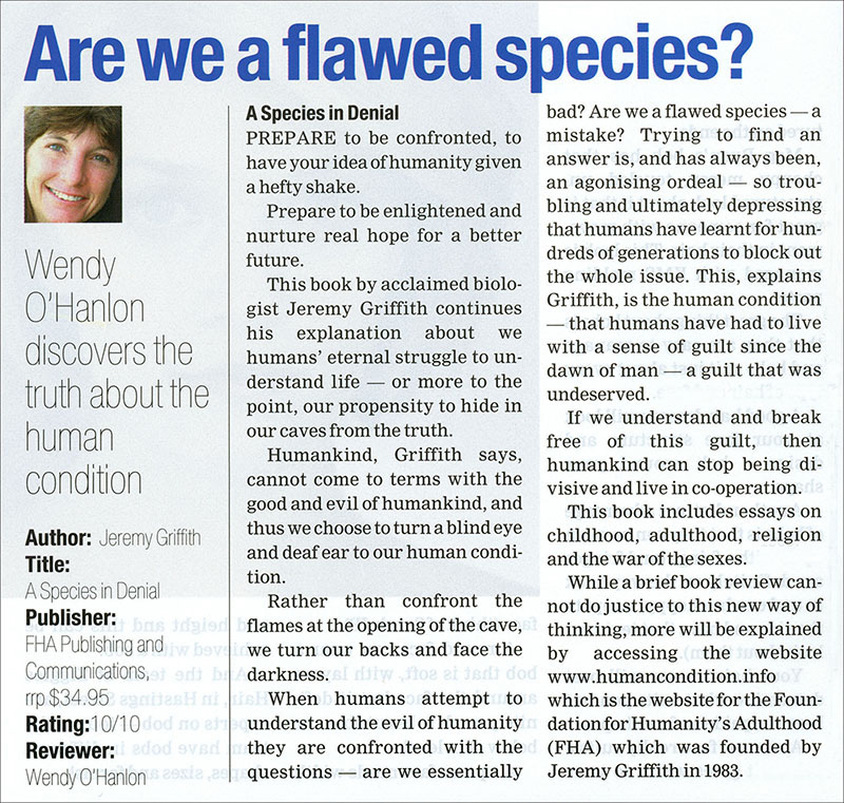
‘Jeremy Griffith is an Australian biologist but his range of interests and his store of knowledge seem almost infinite… The chapter called Resignation is brilliant in its insight into human nature and what we call the idealism of the young… It’s worth reading the book for this essay alone but, of course, there’s so much more. Those who need brain food will find it here. It can’t be said of many books that the world looks different after you’ve read them. It can be said of this book.’
This review appeared on 7 February 2004 in the Toowoomba Chronicle, which has a circulation of 35,649 and services Queensland’s Darling Downs region. Reviewer Antonia Hildebrand has a master’s degree and is an award-winning poet and short-story writer.
A Species In Denial Review by Antonia Hilderbrand.
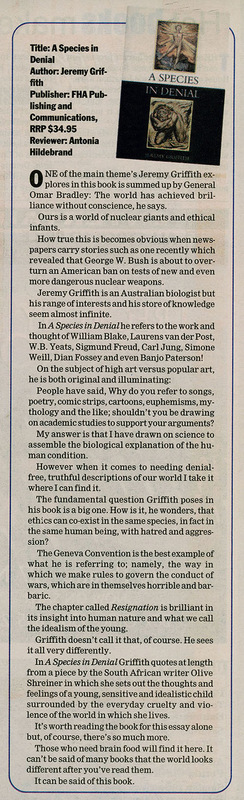
One of the main theme’s Jeremy Griffith explores in this book is summed up by General Omar Bradley: The world has achieved brilliance without conscience, he says.
Ours is a world of nuclear giants and ethical infants.
How true this is becomes obvious when newspapers carry stories such as one recently which revealed that George W. Bush is about to overturn an American ban on tests of new and even more dangerous nuclear weapons. Jeremy Griffith is an Australian biologist but his range of interests and his store of knowledge seem almost infinite.
In A Species In Denial he refers to the work and thought of William Blake, Laurens van der Post, W.B. Yeats, Sigmund Freud, Carl Jung, Simone Weill, Dian Fossey and even Banjo Paterson!
On the subject of high art versus popular art, he is both original and illuminating:
People have said, Why do you refer to songs, poetry, comic strips, cartoons, euphemisms, mythology and the like: shouldn’t you be drawing on academic studies to support your arguments?
My answer is that I have drawn on science to assemble the biological explanation of the human condition.
However when it comes to needing denial-free, truthful descriptions of our world I take it where I can find it.
The fundamental question Griffith poses in his book is a big one. How is it, he wonders, that ethics can co-exist in the same species, in fact in the same human being, with hatred and aggression?
The Geneva Convention is the best example of what he is referring to; namely, the way in which we make rules to govern the conduct of wars, which are in themselves horrible and barbaric.
The chapter called Resignation is brilliant in its insight into human nature and what we call the idealism of the young.
Griffith doesn’t call it that, of course. He sees it all very differently.
In A Species In Denial Griffith quotes at length from a piece by the South African writer Olive Shriener in which she sets out the thoughts and feelings of a young, sensitive and idealistic child surrounded by the everyday cruelty and violence of the world in which she lives.
It’s worth reading the book for this essay alone but, of course, there’s so much more.
Those who need brain food will find it here. It can’t be said of many books that the world looks different after you’ve read them.
It can be said of this book.
‘A Rewarding Journey’
Review in the The Weekend Australian, 19–20 July 2003. Since this review, Ronald Conway has written an even more appreciative review of A Species In Denial in the Jan-Feb 2004 Australian Journal of Contemporary Analysis (included earlier). As he acknowledges in that review, ‘A Species In Denial needs repeated reading’ to gain a full appreciation. (The Weekend Australian is Australia’s only national newspaper, circulation 303,000; readership 910,000).
‘There is no doubt that Jeremy is talking about the big stuff’
The following full-page article appeared in the 3 July 2003 edition of Friday Magazine, a monthly colour magazine distributed in The Land newspaper in NSW, Queensland Country Life, North Queensland Register, Stock and Land (which covers regional and rural Victoria), Stock Journal (which covers regional and rural South Australia) and Farm Weekly (which covers regional and rural Western Australia). It reaches 92% of all farms in Australia and has a combined circulation of 130,000.
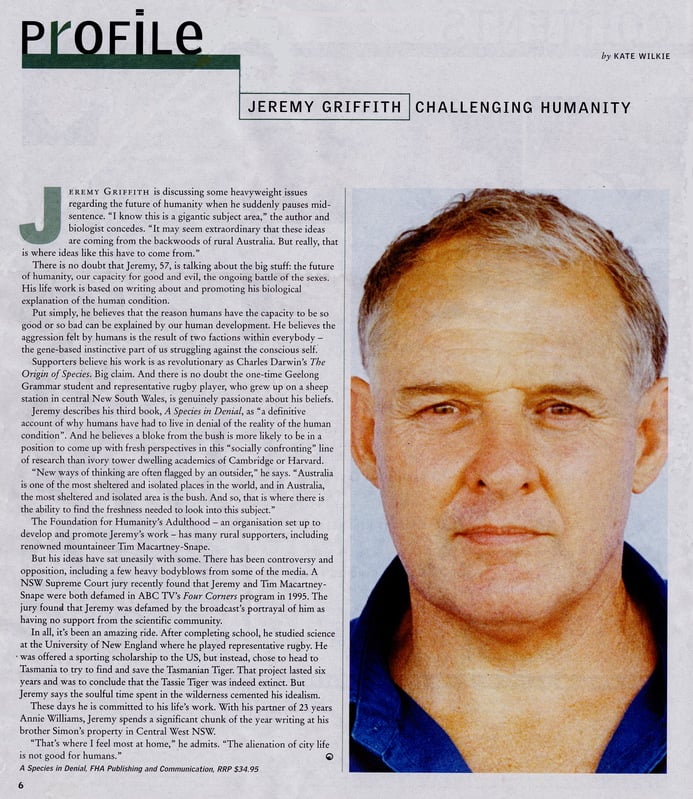
The text in the above article is as follows:
PROFILE : JEREMY GRIFFITH CHALLENGING HUMANITY
By Kate Wilkie
JEREMY GRIFFITH is discussing some heavyweight issues regarding the future of humanity when he suddenly pauses mid sentence. “I know this is a gigantic subject area,” the author and biologist concedes. “It may seem extraordinary that these ideas are coming from the backwoods of rural Australia. But really, that is where ideas like this have to come from.”
There is no doubt that Jeremy, 57, is talking about the big stuff: the future of humanity, our capacity for good and evil, the ongoing battle of the sexes. His life work is based on writing about and promoting his biological explanation of the human condition.
Put simply, he believes that the reason humans have the capacity to be so good or so bad can be explained by our human development. He believes the aggression felt by humans is the result of two factions within everybody—the gene-based instinctive part of us struggling against the conscious self.
Supporters believe his work is as revolutionary as Charles Darwin’s The Origin of Species. Big claim. And there is no doubt the one-time Geelong Grammar Student and representative rugby player, who grew up on a sheep station in central New South Wales, is genuinely passionate about his beliefs.
Jeremy describes his third book, A Species in Denial, as “a definitive account of why humans have had to live in denial of the reality of the human condition”. And he believes a bloke from the bush is more likely to be in a position to come up with fresh perspectives in this “socially confronting” line of research than ivory tower dwelling academics of Cambridge or Harvard.
“New ways of thinking are often flagged by an outsider,” he says. “Australia is one of the most sheltered and isolated places in the world, and in Australia, the most sheltered and isolated area is the bush. And so, that is where there is the ability to find the freshness needed to look into this subject.”
The Foundation for Humanity’s Adulthood — an organization set up to develop and promote Jeremy’s work — has many rural supporters, including renowned mountaineer Tim Macartney-Snape.
But his ideas have sat uneasily with some. There has been controversy and opposition, including a few heavy bodyblows from some of the media. A NSW Supreme Court jury recently found that Jeremy and Tim Macartney-Snape were both defamed in ABC TV’s Four Corners program in 1995. The jury found that Jeremy was defamed by the broadcast’s portrayal of him as having no support from the scientific community.
In all, it’s been an amazing ride. After completing school, he studied science at the University of New England where he played representative rugby. He was offered a sporting scholarship to the US, but instead, chose to head to Tasmania to try to find and save the Tasmanian Tiger. That project lasted six years and was to conclude that the Tassie Tiger was indeed extinct. But Jeremy says the soulful time spent in the wilderness cemented his idealism.
These days he is committed to his life’s work. With his partner of 23 years Annie Williams, Jeremy spends a significant chunk of the year writing at his brother Simon’s property in Central West NSW.
“That’s where I feel most at home,” he admits. “The alienation of city life is not good for humans.”
A Species in Denial, FHA Publishing and Communication, RRP $34.95
‘A Heroic Work’
This review appeared on 4 October 2003 in the Weekender section of the Townsville Bulletin (circulation of 43,500) and the Townsville Sun (circulation of 51,500).
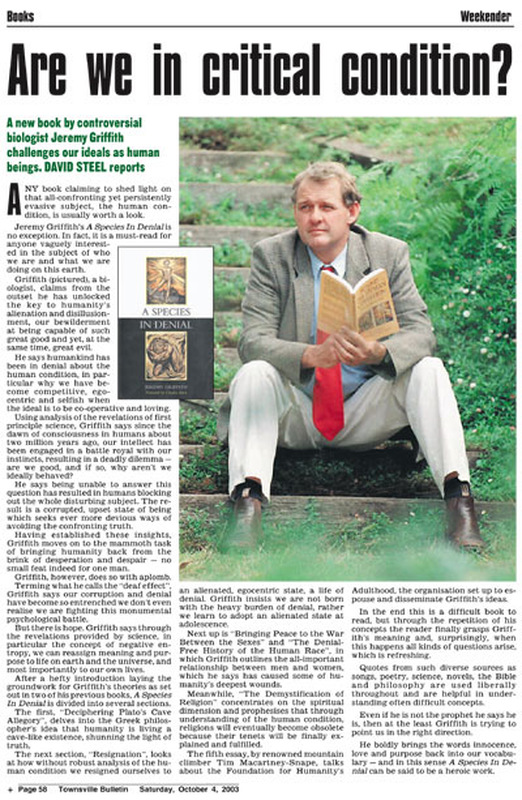
The text in the above article is as follows:
Are we in critical condition?
A new book by controversial biologist Jeremy Griffith challenges our ideals as human beings. DAVID STEEL reports
ANY book claiming to shed light on that all-confronting yet persistently evasive subject, the human condition, is usually worth a look.
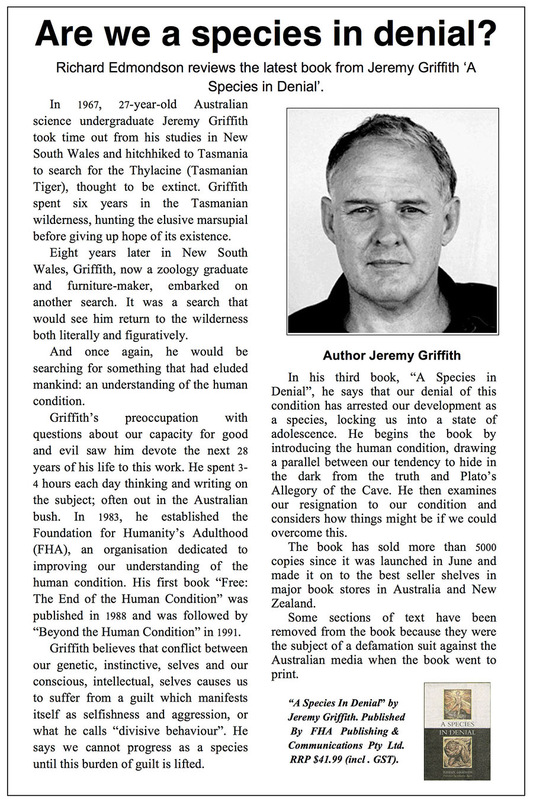
Jeremy Griffith’s A Species In Denial is no exception. In fact, it is a must-read for anyone vaguely interested in the subject of who we are and what we are doing on this earth.
Griffith (pictured), a biologist, claims from the outset he has unlocked the key to humanity’s alienation and disillusionment, our bewilderment at being capable of such great good and yet, at the same time, great evil.
He says humankind has been in denial about the human condition, in particular why we have become competitive, egocentric and selfish when the ideal is to be co-operative and loving.
Using analysis of the revelations of first principle science, Griffith says since the dawn of consciousness in humans about two million years ago, our intellect has been engaged in a battle royal with our instincts, resulting in a deadly dilemma — are we good, and if so, why aren’t we ideally behaved?
He says being unable to answer this question has resulted in humans blocking out the whole disturbing subject. The result is a corrupted, upset state of being which seeks ever more devious ways of avoiding the confronting truth.
Having established these insights, Griffith moves on to the mammoth task of bringing humanity back from the brink of desperation and despair — no small feat indeed for one man.
Griffith, however, does so with aplomb.
Terming what he calls the “deaf effect”, Griffith says our corruption and denial have become so entrenched we don’t even realise we are fighting this monumental psychological battle.
But there is hope. Griffith says through the revelations provided by science, in particular the concept of negative entropy, we can reassign meaning and purpose to life on earth and the universe, and most importantly to our own lives.
After a hefty introduction laying the groundwork for Griffith’s theories as set out in two of his previous books, A Species In Denial is divided into several sections.
The first, “Deciphering Plato’s Cave Allegory”, delves into the Greek philosopher’s idea that humanity is living a cave-like existence, shunning the light of truth.
The next section, “Resignation”, looks at how without robust analysis of the human condition we resigned ourselves to an alienated, egocentric state, a life of denial. Griffith insists we are not born with the heavy burden of denial, rather we learn to adopt an alienated state at adolescence.
Next up is “Bringing Peace to the War Between the Sexes” and “The Denial-Free History of the Human Race”, in which Griffith outlines the all-important relationship between men and women, which he says has caused some of humanity’s deepest wounds.
Meanwhile, “The Demystification of Religion” concentrates on the spiritual dimension and prophesises that through understanding of the human condition, religions will eventually become obsolete because their tenets will be finally explained and fulfilled.
The fifth essay, by renowned mountain climber Tim Macartney-Snape, talks about the Foundation for Humanity’s Adulthood, the organisation set up to espouse and disseminate Griffith’s ideas.
In the end this is a difficult book to read, but through the repetition of his concepts the reader finally grasps Griffith’s meaning and, surprisingly, when this happens all kinds of questions arise, which is refreshing.
Quotes from such diverse sources as songs, poetry, science, novels, the Bible and philosophy are used liberally throughout and are helpful in understanding often difficult concepts.
Even if he is not the prophet he says he is, then at the least Griffith is trying to point us in the right direction.
He boldly brings the words innocence, love and purpose back into our vocabulary — and in this sense A Species In Denial can be said to be a heroic work.
‘There is no doubt that this book is an important one and breathtaking in its breadth…the psychological and biological stages of life are examined with great insight…For thinking adolescents and beyond.’
This review appeared in the ‘Professional Interest’ section of the May 2004 edition of Reading Time, the quarterly journal of the Children’s Book Council of Australia. The journal has a circulation of up to 1,800 subscribers, mainly private and public primary and secondary school libraries in Australia and New Zealand.
**GRIFFITH, Jeremy A Species In Denial Foundation for Humanity’s Adulthood, 2003 526pp $34.95 pbk ISBN 1741290007 SCIS 1135226
The thesis of this book is that humanity is in denial about the loss of its innocence in a corrupt and broken world. Young children generally live in a state of innocence until adolescence but when the truth of evil breaks into their lives then they may well be led to the precipice of suicide or beyond. For most adults they come to suppress the awfulness of the condition instead of confronting it head on. This book opens up the whole issue and demands that we as human beings work through the task to arrive at an equilibrium that will allow for full and fruitful lives. The psychological and biological stages of life are examined with great insight yet to my mind it fails to look satisfactorily at the resilience of the human spirit. I would have liked some discussion of the works of Buber, H. Richard Niebuhr, Kohlberg and Fowler to name a few who have examined the moral stages of human growth to be included. There is no doubt that this book is an important one and breathtaking in its breadth but the answer or answers to the question about the human condition have yet to be concluded. For thinking adolescents and beyond. JC
______________________
Note – JC are the initials of the reviewer, John Cohen, the editor of Reading Time.
The Sydney Institute Quarterly Review
The following review appeared in The Sydney Institute Quarterly, Issue 21, Vol. 7, Nos. 3&4, November, 2003, page 33.
The Sydney Institute is a privately funded, current affairs forum that enjoys good relations with both sides of Australian politics. Many dignitaries have spoken at the Institute, including (as at 2003) the Prime Minister John Howard, the former Opposition Leader Simon Crean, Chief Justice Murray Gleeson, Reserve Bank Governor Ian Macfarlane and US Vice-President Dick Cheney. The Institute receives support from the Australian business community, as well as from editors, writers and members of the professional community. The Sydney Institute Quarterly is distributed to the Institute’s 2,000 members.
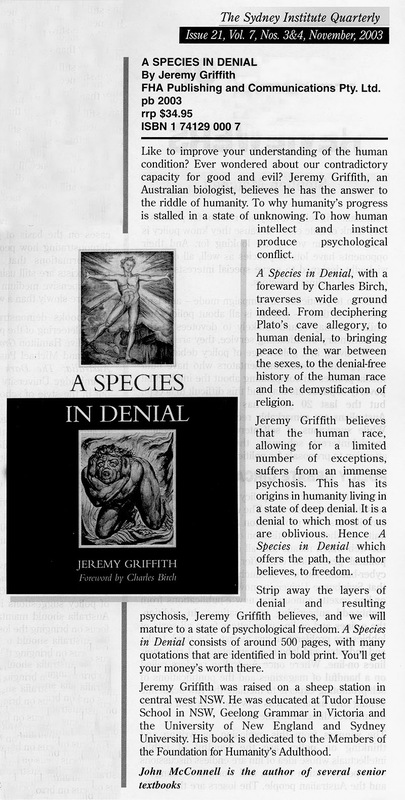
‘Landmark in understanding’
This review appeared on 23 August 2003 in The Geelong Advertiser, which services the Barwon region of Victoria and has a circulation of 45,709.
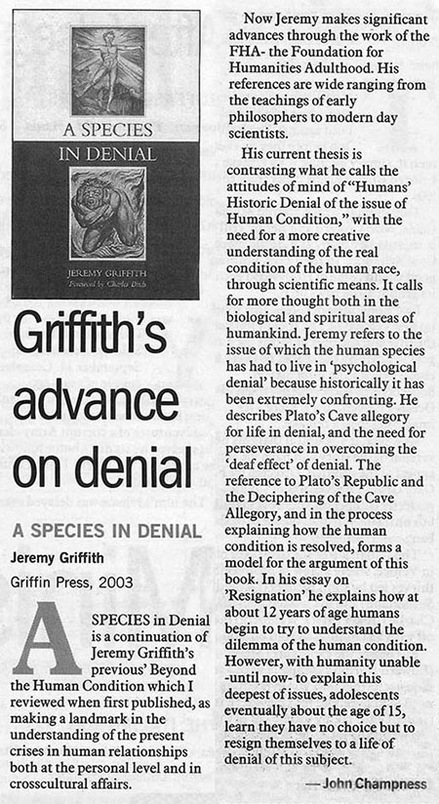
NOTE: Since writing his above review Dr Champness has written to the FHA commending A Species In Denial as ‘a breakthrough in understanding the human condition’.
‘Why did the strong always crush the weak? Why did we hate and kill and torture?…this book will provide [you with] some answers’
This review appeared on 19 January 2004 in the Taupo Weekender in New Zealand, which has a circulation of 15,300.
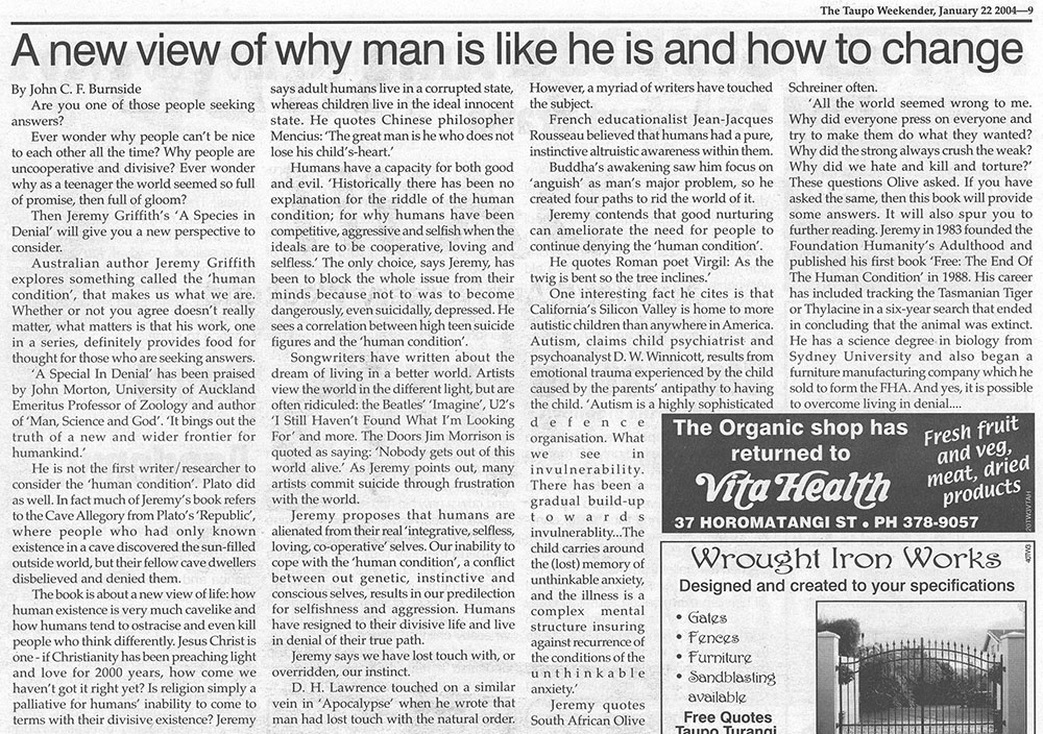
The text in the above article is as follows:
A new view of why man is like he is and how to change
By John C. F. Burnside
Are you one of those people seeking answers?
Ever wonder why people can’t be nice to each other all the time? Why people are uncooperative and divisive? Ever wonder why as a teenager the world seemed so full of promise, then full of gloom?
Then Jeremy Griffith’s ‘A Species in Denial’ will give you a new perspective to consider.
Australian author Jeremy Griffith explores something called the ‘human condition’, that makes us what we are. Whether or not you agree doesn’t really matter, what matters is that his work, one in a series, definitely provides food for thought for those who are seeking answers.
‘A Special In Denial’ has been praised by John Morton, University of Auckland Emeritus Professor of Zoology and author of ‘Man, Science and God’. ‘It brings out the truth of a new and wider frontier for humankind.’
He is not the first writer/researcher to consider the ‘human condition’. Plato did as well. In fact much of Jeremy’s book refers to the Cave Allegory from Plato’s ‘Republic’, where people who had only known existence in a cave discovered the sun-filled outside world, but their fellow cave dwellers disbelieved and denied them.
The book is about a new view of life: how human existence is very much cavelike and how humans tend to ostracise and even kill people who think differently. Jesus Christ is one – if Christianity has been preaching light and love for 2000 years, how come we haven’t got it right yet? Is religion simply a palliative for humans’ inability to come to terms with their divisive existence? Jeremy says adult humans live in a corrupted state, whereas children live in the ideal innocent state. He quotes Chinese philosopher Mencius: ‘The great man is he who does not lose his child’s-heart.’
Humans have a capacity for both good and evil. ‘Historically there has been no explanation for the riddle of the human condition; for why humans have been competitive, aggressive and selfish when the ideals are to be cooperative, loving and selfless.’ The only choice, says Jeremy, has been to block the whole issue from their minds because not to was to become dangerously, even suicidally, depressed. He sees a correlation between high teen suicide figures and the ‘human condition’.
Songwriters have written about the dream of living in a better world. Artists view the world in the different light, but are often ridiculed: the Beatles’ ‘Imagine’, U2’s ‘I Still Haven’t Found What I’m Looking For’ and more. The Doors Jim Morrison is quoted as saying: ‘Nobody gets out of this world alive.’ As Jeremy points out, many artists commit suicide through frustration with the world.
Jeremy proposes that humans are alienated from their real ‘integrative, selfless, loving, co-operative’ selves. Our inability to cope with the ‘human condition’, a conflict between our genetic, instinctive and conscious selves, results in our predilection for selfishness and aggression. Humans have resigned to their divisive life and live in denial of their true path.
Jeremy says we have lost touch with, or overridden, our instinct.
D. H. Lawrence touched on a similar vein in ‘Apocalypse’ when he wrote that man had lost touch with the natural order. However, a myriad of writers have touched the subject.
French educationalist Jean-Jacques Rousseau believed that humans had a pure, instinctive altruistic awareness within them.
Buddha’s awakening saw him focus on ‘anguish’ as man’s major problem, so he created four paths to rid the world of it.
Jeremy contends that good nurturing can ameliorate the need for people to continue denying the ‘human condition’.
He quotes Roman poet Virgil: ‘As the twig is bent so the tree inclines.’
One interesting fact he cites is that California’s Silicon Valley is home to more autistic children than anywhere in America. Autism, claims child psychiatrist and psychoanalyst D. W. Winnicott, results from emotional trauma experienced by the child caused by the parents’ antipathy to having the child. ‘Autism is a highly sophisticated defence organisation. What we see in invulnerability. There has been a gradual build-up towards invulnerability…The child carries around the (lost) memory of unthinkable anxiety, and the illness is a complex mental structure insuring against recurrence of the conditions of the unthinkable anxiety.’
Jeremy quotes South African Olive Schreiner often.
‘All the world seemed wrong to me. Why did everyone press on everyone and try to make them do what they wanted? Why did the strong always crush the weak? Why did we hate and kill and torture?’ These questions Olive asked. If you have asked the same, then this book will provide some answers. It will also spur you to further reading. Jeremy in 1983 founded the Foundation for Humanity’s Adulthood and published his first book ‘Free: The End Of The Human Condition’ in 1988. His career has included tracking the Tasmanian Tiger or Thylacine in a six-year search that ended in concluding that the animal was extinct. He has a science degree in biology from Sydney University and also began a furniture manufacturing company which he sold to form the FHA. And yes, it is possible to overcome living in denial….
A review in Northern News (New Zealand)
The following review of A Species In Denial appeared in The Northern News on 3 September 2003, which services areas of the North Island of New Zealand (circulation of 14,000).
‘a must read for all…most rewarding’
This review appeared on 1 November 2003 in The Southland Times, the major newspaper for New Zealand’s South Island, with a weekly readership of 77,000. The Southland Times also publishes a daily Central Otago edition for distribution in Queenstown, Wanaka, Cromwell, Alexandra and surrounding areas.
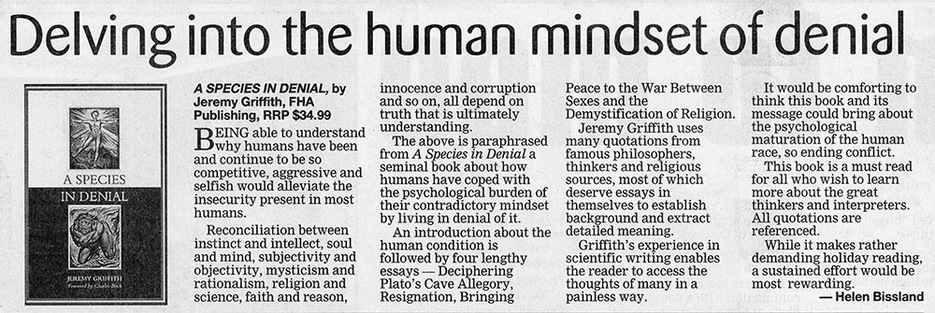
The text in the above article is as follows:
Delving into the human mindset of denial
A SPECIES IN DENIAL by Jeremy Griffith, FHA Publishing, RRP $34.99
BEING able to understand why humans have been and continue to be so competitive, aggressive and selfish would alleviate the insecurity present in most humans. Reconciliation between instinct and intellect, soul and mind, subjectivity and objectivity, mysticism and rationalism, religion and science, faith and reason, innocence and corruption and so on, all depend on truth that is ultimately understanding.
The above is paraphrased from A Species in Denial a seminal book about how humans have coped with the psychological burden of their contradictory mindset by living in denial of it.
An introduction about the human condition is followed by four lengthy essays—Deciphering Plato’s Cave Allegory, Resignation, Bringing Peace to the War Between Sexes and the Demystification of Religion.
Jeremy Griffith uses many quotations from famous philosophers, thinkers and religious sources, most of which deserve essays in themselves to establish background and extract detailed meaning. Griffith’s experience in scientific writing enables the reader to access the thoughts of many in a painless way.
It would be comforting to think this book and its message could bring about the psychological maturation of the human race, so ending conflict.
This book is a must read for all who wish to learn more about the great thinkers and interpreters. All quotations are referenced. While it makes rather demanding holiday reading, a sustained effort would be most rewarding. — Helen Bissland
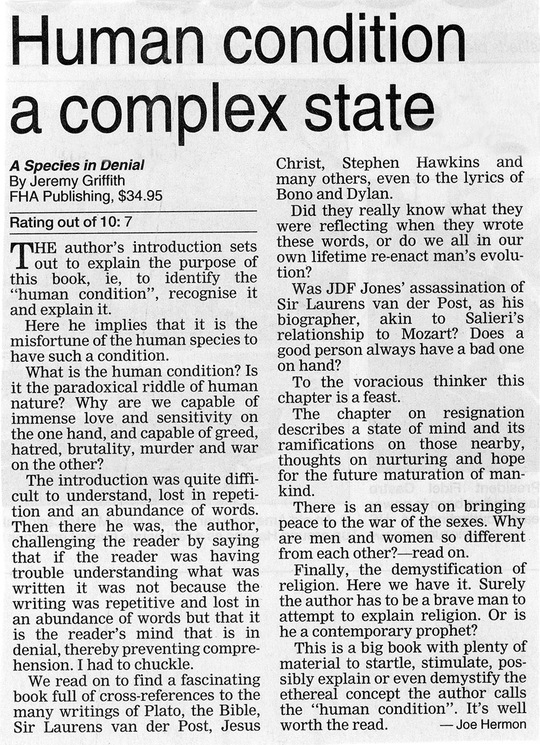
‘a fascinating book…a feast…well worth the read’
This review appeared on 29 October 2003 in The Northern Advocate, a paper servicing Northland, New Zealand, and a readership of 40,000.
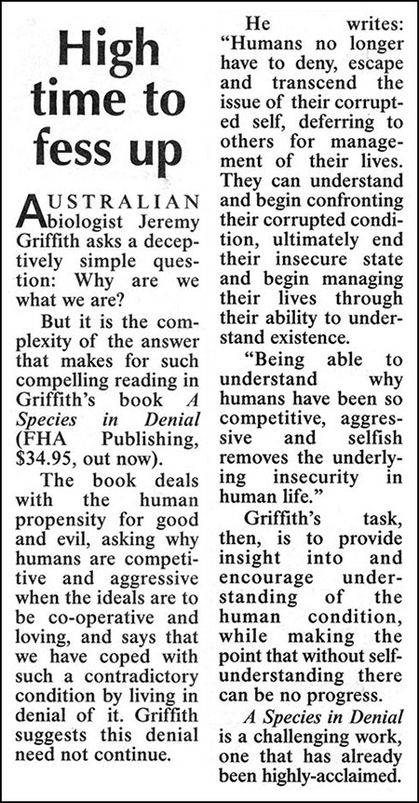
‘Compelling reading’
This review appeared on 20 September 2003 in the Weekender Section of The Gold Coast Bulletin, which services the Gold Coast region of Queensland and has a circulation of 79,600.
‘Book offers Solution instead of Bandaid’
This letter to the Editor appeared on 25 September 2003 in The Northern Daily Leader, which covers the north-west region of NSW and has a circulation of 24,000.

The text in the above article is as follows:
Book offers solution instead of bandaid
OFTEN I read letters in this column that despair of the destructive, unstable state of the world today. The youth drug/alcohol abuse problem, suicide, the breakdown of the family unit, poverty in Third World countries and environmental abuse, for example.
Other times I read letters that offer solutions to these problems and ways that we can solve them. I’ll use the youth drug/alcohol problem as a recent example as quite often there are readers who share their ideas on what is causing the problem, and how society should tackle this worsening crisis.
It’s true. There IS a drug and alcohol problem in our community. However, this problem is not simply a result of poor drug education in schools, boredom, the desire to experiment, less than ideal family units, keeping the wrong company, low self esteem, lack of direction or religious faith — all reasons that are thrown around from time to time. The problem is much, much greater. These are all just symptoms of a much bigger problem.
The trouble is none of these “solutions”, actually reach the core of the problem. For example, the real problem is not that kids are binge drinking at thirteen and spraying walls with profane outbursts or that girls and boys are having sex resulting in unwanted pregnancies. These are simply the result of the bigger problems facing mankind. Superior drug/ alcohol or sex education in schools won’t go close to addressing this problem.
In today’s world we don’t have to look far to know that we need a solution, not a band-aid. It’s time we all understood the crux of the problem here on earth. Human beings are capable of the most atrocious acts, but they are also capable of incredible acts of love. Good and evil, if you like.
We’ve seen people fly planes into buildings, Mothers and Fathers murder their own children and massive wars. There is an explanation for this suffering and pain and there is a solution, that is neither short- sighted or a band-aid. It’s no longer good enough for people to hide behind faith and band-aid solutions. It really is time to take a step back and take a good look at the big picture. The good intentions of so many individuals and organisations are simply that. They are not going to solve the biggest problem of humankind.
The biggest problem that faces human kind IS human kind itself. Our problems, and the state of the world are counter effects of a much more significant problem, namely human beings and our human condition. The human condition being our ingrained insecurity arising from our inability to reckon with and understand our capacity for acts of good and evil.
Only once we address the much larger, all consuming challenge of bringing dignifying understanding to the human condition, will we witness the subsidence of the problems facing mankind today.
I challenge any one who is sceptical about what I am saying, to get a hold of the book A Species In Denial (Jeremy Griffith 2003), to read it, digest it and then see if it doesn’t knock your socks off. This particular book is already a bestseller and it’s no wonder. There really is only one solution to the massive problem facing the world today. This problem is explained in the book and the solution is there for anyone brave enough to look at it.
Sophie Leyden
OGILVIE ST DENMAN
‘Help is at hand’
This review appeared on 3 October 2003 in The Manawatu Standard (circulation of 20,360 and readership of 51,000), the daily newspaper for Palmerson North, the fifth largest city in New Zealand (on the North Island near Wellington).
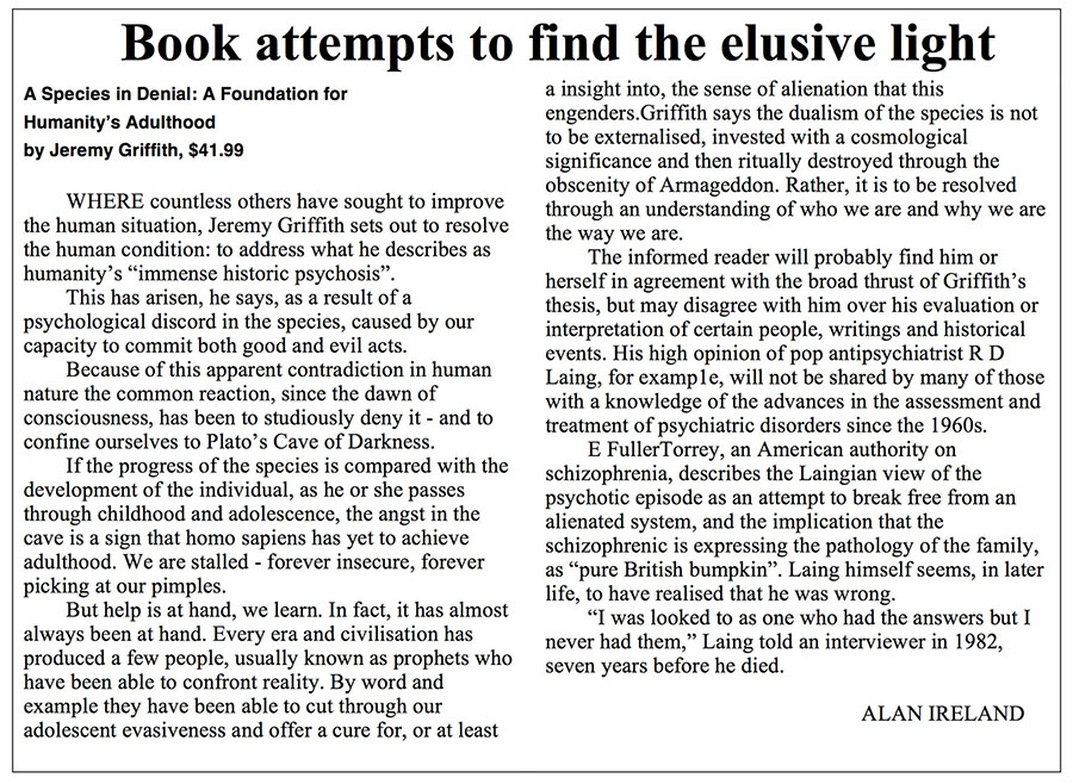
The text in the above article is as follows:
Book attempts to find the elusive light
WHERE countless others have sought to improve the human situation, Jeremy Griffith sets out to resolve the human condition: to address what he describes as humanity’s “immense historic psychosis”.
This has arisen, he says, as a result of a psychological discord in the species, caused by our capacity to commit both good and evil acts.
Because of this apparent contradiction in human nature the common reaction, since the dawn of consciousness, has been to studiously deny it – and to confine ourselves to Plato’s Cave of Darkness.
If the progress of the species is compared with the development of the individual, as he or she passes through childhood and adolescence, the angst in the cave is a sign that homo sapiens has yet to achieve adulthood. We are stalled – forever insecure, forever picking at our pimples.
But help is at hand, we learn. In fact, it has almost always been at hand. Every era and civilisation has produced a few people, usually known as prophets who have been able to confront reality. By word and example they have been able to cut through our adolescent evasiveness and offer a cure for, or at least a insight into, the sense of alienation that this engenders.
Griffith says the dualism of the species is not to be externalised, invested with a cosmological significance and then ritually destroyed through the obscenity of Armageddon. Rather, it is to be resolved through an understanding of who we are and why we are the way we are.
The informed reader will probably find him or herself in agreement with the broad thrust of Griffith’s thesis, but may disagree with him over his evaluation or interpretation of certain people, writings and historical events. His high opinion of pop antipsychiatrist R D Laing, for example, will not be shared by many of those with a knowledge of the advances in the assessment and treatment of psychiatric disorders since the 1960s.
E FullerTorrey, an American authority on schizophrenia, describes the Laingian view of the psychotic episode as an attempt to break free from an alienated system, and the implication that the schizophrenic is expressing the pathology of the family, as “pure British bumpkin”. Laing himself seems, in later life, to have realised that he was wrong.
“I was looked to as one who had the answers but I never had them,” Laing told an interviewer in 1982, seven years before he died.
ALAN IRELAND
WTM Note: R.D. Laing never said his views on the causes of psychiatric disorders were wrong and his acknowledgement that he didn’t have the answers to the human condition is acknowledged on page 250 of A Species In Denial.
‘There is a lot to think about in this book [requiring] a second or even third reading’
This review appeared on 15 November 2003 in The Timaru Herald, which is located on the South Island of New Zealand (circulation of 14,000, and readership of 30,000).
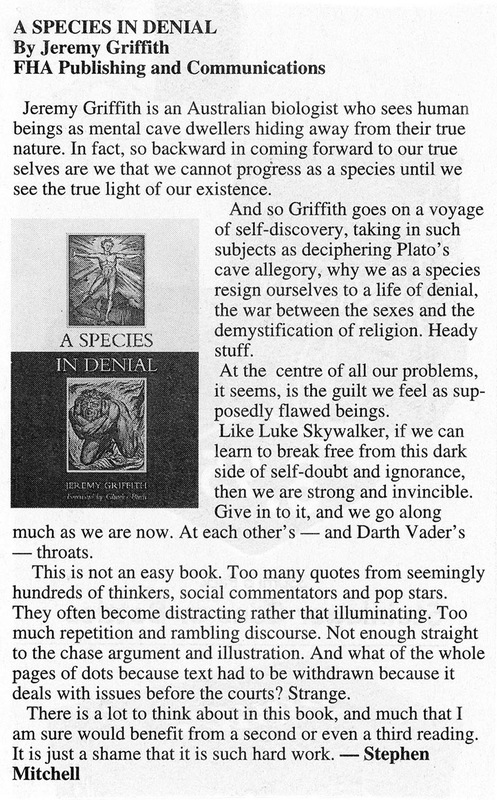
Note: The reason the book is ‘hard work’ for some is because of the difficulty the human mind has reading about a subject it has learnt to fear, block out and live in denial of. There is evidence for this is in the Readers Responses section, which shows the extraordinary ease with which some people read and absorb, and indeed can’t get enough of, this book.
The University of Sydney website
On 14 November 2003 the University of Sydney’s website, in the ‘Book Review’ section under ‘News and Events’, mentioned Charles Birch’s new book Life and Work: Challenging Economic Man, and also A Species In Denial:
‘Charles Birch also wrote the foreword to the recently published A Species In Denial by Australian biologist Jeremy Griffith. The book deals with humanity’s disturbing capacity for both good and evil, and how people have tried to come to terms with the contradictory human condition. In his foreword, Professor Birch differentiates between the two main streams of thought concerning the nature of things: subjective and objective. “The universe may have mechanical aspects, but it is also a feeling universe” he writes. A Species In Denial is published by FHA Publishing and Communications.’
Interesting academic references to A Species In Denial that were brought to our attention following its launch
A Species In Denial was listed in The Journal of the Royal Anthropological Institute, 11(1), p.187, March 2005.
A Species In Denial was listed in The Heythrop Journal, 46 (1), p.130–133, January 2005.
A Species In Denial was listed in the Journal of Consciousness Studies, 11, No. 9, 2004, p.75
A Species In Denial was referenced in a conceptual paper in the Journal of Knowledge Management, Vol 8 (5), May 2004, p. 28-46 (19). The paper was titled Capital Cities:a taxonomy of capital accounts for knowledge cities and was written by Dr Francisco J Carrillo, Chairman of the World Capital Institute and Director of the Center for Knowledge Systems at Tecnologico de Monterrey, Mexico. Dr Carrillo also referenced A Species In Denial at the International Forum: La Innovacion en la Sociedad del Conocimiento (Innovation in the Society of Knowledge) in his presentation, Experiencias Internacionales en la conformacion de ciudades del conocimiento (International Experiences in the Conformation of Knowledge), Colombia 28 Oct. 2004.
A Species In Denial was listed in the Australian Journal of Social Issues, August, 2004.
A Species In Denial was referenced on a website called Co-Op World on a webpage called ‘Helping Communities Connect’.
On page 18 of the paper Becoming Ecosyncronous: Sustainability, Ethics and Personal Development the author cites A Species In Denial as a reference. This paper was presented at the Academic Forum of Regional Governance for Sustainable Development, held in Perth, Western Australia, 17-19 September 2003. It was written by Dr Bob Hay of the Policy & Sustainability Branch, Department of Environment, State Government WA and Sessional Lecturer, Department of Environmental Biology, Curtin University of Technology Perth, WA. Dr Hay also referenced A Species In Denial in an expanded article version of the above paper that was titled Becoming Ecosynchronous, part 1. The root causes of our unsustainable way of life in an online journal Sustainable Development, 13, issue 5, p. 311–325, August 2005.
On page 11 of the paper titled Organisational Behaviour: Back to the Future the author cites A Species In Denial as a reference. The paper appeared in the Journal of Doing Business Across Borders Vol 2(2) [2003] and was written by Peter J. Hosie, Edith Cowan University, Roger C. Smith, The University of Western Australia and Charles J. Cunningham, aussiehome.com.
In March 2005, A Species In Denial was listed as a recommended ‘Cool Book’ or book of the month for members of an online discussion group of honours graduates at the Virginia Polytechnic Institute and State University in the United States.
A link to the FHA’s website and the following description of the FHA and presumably its latest book A Species In Denial are listed in the organisation directory on a website called ‘Re-establishing Altruism As A Viable Social Norm’, which can be viewed at www.altruists.org/directory/visionaries/: ‘The Foundation for Humanity’s Adulthood: This Australian charity formed to explore the human condition has published a thought-provoking book about the evolution of human nature. It points the way towards the evolution of a positive, all inclusive society dominated by universal love.’
The prestigious US men’s magazine Esquire featured an article by Chris Jones (Dec 2004) on National Football League player Ricky Williams which mentioned A Species In Denial as one of the books Williams read while on holiday in Australia.
A sermon published on the internet in 2004, titled ‘The Hill Called Difficulty’ by Rev. Dr. David Thompson for the Westminster Presbyterian Church in the US, quotes from Jeremy Griffith’s description of Sir Laurens van der Post in A Species In Denial.
The following reviews of A Species In Denial
currently appear on www.amazon.com
‘As a PhD student…in molecular biology…Griffith’s explanation seems logical and it provides a plausible basis from which to explain such human behaviours as religion and the interaction between men and women. Such behaviours have previously attempted to be accounted for in a scientific context by the reductionist theory of the ‘selfish gene’, which had its limitations…This book is thought provoking at the very least…[it] deserves a lot of thought.’

Customer Reviews
Avg. Customer Review :
Worthy of serious thought, April 22, 2004
Reviewer: Anna Fitzgerald from Auckland, New Zealand
Approaching ‘A Species In Denial’ as a PhD student, whose research is based in molecular biology, scepticism was almost unavoidable. Such is the in-grained methodology practiced by scientists. New ideas that challenge current schools of thought need to be proven before they are accepted. This however is hard when you are dealing with the immense subject matter broached in this book. In spite of this Griffith’s explanation seems logical and it provides a plausible basis from which to explain such human behaviours as religion and the interaction between men and women. Such behaviours have previously attempted to be accounted for in a scientific context by the reductionist theory of the ‘selfish gene’, which had its limitations.
In ‘A Species In Denial’, Griffith summarises the biology upon which his ideas are based. His earlier book ‘Free: End of the Human Condition’, details the biology. In essence, Griffith suggests the onset of the human condition was brought about by the development of consciousness. Our instinctive nature, a product, he says, of the tendency in nature to form wholes (known as ‘negative entropy’) was to be co-operative. However this newly found ability to make conscious decisions often veered us from this co-operative path, and conflict between our instinctive and conscious thoughts inevitably arose.
Griffith proposes this clash caused us to become insecure because our instincts were in effect telling us we were ‘bad’ to deviate from their orientation. Unable to explain the biological reason why we had to diverge, we could only defend ourselves by becoming angry toward the ‘criticism’, and become preoccupied with proving our worth: in other words become egocentric.
Griffith says that we adults are all variously living in denial of our immense insecurity and egocentricity, which in turn dictates how we now live. Whilst Griffith says this is an incredibly courageous state, it is also clearly destructive. However with understanding of the source of the insecurity the divisive compensating behaviours now become redundant.
The subject of Griffith’s first essay is Plato’s famous ‘cave analogy’, which appears to give to support to this idea that we are all living in denial. The rest of the book deals with demonstrating the theory’s ability to explain: that often difficult period of adolescence when we transform from being children to adults, which Griffith explains as ‘resigning’ to living in this world of denial of the falseness of our egocentric driven lives; the interaction between men and women; and religion. Griffith collates the writings of many profound thinkers supporting the conclusions he draws.
This book is thought provoking at the very least: it deals with the big issues and in no uncertain terms, claims to solve them. It is also very confronting: nobody wants to be told that they are insecure and egocentric, even though Griffith is defending that insecurity and egocentricity with his biological explanation of the source. This deserves a lot of thought.
‘A controversial book because it dares to look into the issue of human alienation; it dares to confront the issue of self…[it] doesn’t condemn humans, it dignifies them…The orthodoxies are everywhere challenged in this book, but challenged they need to be. I suggest that a book of such fundamental honesty is overdue…[as] an honours graduate in biology I see that A Species In Denial is about human biology…For all its audacity in exposing the extent and variety of human alienation, it is an incredibly brave & important book.’
A brave and important book, April 20, 2004
Reviewer: Marcus Rowell from Sydney, NSW Australia
A Species In Denial by Jeremy Griffith is a controversial book because it dares to look into the issue of human alienation; it dares to confront the issue of self. The book is titled “A Species In Denial” because humans have been unable to deal with the issue of self, the issue of the human condition, the extent of our divided, alienated, ‘fallen’ state.
What is so extraordinary and important is that this bringing to the surface of the issue of our incredibly divided selves is made possible by the central thesis of the book which is the biological explanation for WHY this divided self has been highly necessary. The book doesn’t condemn humans, it dignifies them. It explains that they are ‘good’ and not ‘bad’ after all. It explains the origin of, so called ‘sin’ or ‘evil’, and by so doing lifts the ‘burden of guilt’ from humanity. I suggest people are offended by the honesty of this book and fail to reach this deeper, all-important reconciling understanding in the book that makes the honesty in it both possible and necessary.
To go outside the historic denial of the human condition necessitates heresies on many fronts. The orthodoxies are everywhere challenged in this book, but challenged they need to be. I suggest that a book of such fundamental honesty is overdue.
When Charles Darwin presented his book, the Origins of Species, and demystified humans by linking them with animals, the establishment or orthodoxy was so angered by the heresy that it took a great deal of courage for people to focus on the science of the idea and discover its validity. Science now accepts Darwin’s Theory and in fact a great deal of scientific knowledge has been built upon it.
I am an honours graduate in biology and have been assessing the ideas that Griffith presents in A Species In Denial and his earlier books about the human condition since 1992. I see that A Species In Denial is about human biology, about how humans evolved from an instinctive animal to a fully conscious being and how that resulted in us having to live in denial of our contradictory natures. It is this dilemma of the human condition, this issue of good and evil in the human makeup, that A Species In Denial at last reconciles. For all its audacity in exposing the extent and variety of human alienation, it is an incredibly brave & important book.
The science behind this book is so simple that it could be assessed, evaluated and verified by school children, yet I have seen some respected scientists and academics become so offended by the outright honesty of this book, that they fail to even consider the basic scientific processes described in it.
Response to this book is extremely polarised. We must ask ourselves why many eminent and qualified people can see such merit in A Species In Denial and others attack it so ferociously without ever tackling the ideas.
I strongly recommend you read the book and see for yourself if this book isn’t almost unbearably honest and discover the real reason behind the extreme animosity from some people. Denials naturally resist exposure because they are so embedded, especially a denial of this scale where virtually all of humanity is involved, but our freedom as a species lies beyond living in our dungeon state of denial. More power to this book.
‘…this is the only book that makes sense of the many questions that I thought were unanswerable…[it] will shatter many conventional views and shake people’s foundations but I am so thankful that someone actually has had the guts to write this book and then some more to go ahead and publish it.’
What an amazing book, February 10, 2004
Reviewer: Miranda Ellis
I have just finished reading A Species In Denial and I must congratulate author Jeremy Griffith for re-igniting my faith in humanity.
This book’s exploration and explanation of all aspects of what it is to be human is remarkable, in particular the essay on men and women titled “Bringing Peace to the War Between the Sexes”. It is provocative and challenges feminist and political correct thinking. It even explains that men are not what women have thought they are – monsters only interested in reproducing their own genes. It explains that men are heroes and not the villains that we thought they were of the human journey.
I have read some of the popular literature on human psychology and this is the only book that makes sense of the many questions that I thought were unanswerable. What strikes me most is how compassionate the author is about humans, that we are worthwhile despite all our frailties. I encourage everyone to read this book as I think it is meant for everyone to read.
But be warned this book is extremely confronting as it really makes you take a good hard look at yourself and the world around you – I am still in shock that yes I am living in denial of the human condition, sitting still in my comfort zone happily ignoring the atrocities that humans deal out to each other and nature everyday. It’s given me a massive wake up call and I am excited that there is potential for a real future for humanity, not one marred by superficiality and anger. I have no doubt this book will shatter many conventional views and shake people’s foundations but I am so thankful that someone actually has had the guts to write this book and then some more to go ahead and publish it.
‘It is the greatest book on the planet, no wait, in the universe. In fact it is the greatest anything in the universe…this book really deserves all the praise it can get.’
Arriving at the gates, December 4, 2004
Reviewer: Beta

As I write this review, tears stream down my face, so overcome have I been by this book. It is the greatest book on the planet, no wait, in the universe. In fact it is the greatest anything in the universe.
As I read the title, my mortgage was suddenly paid off. I read the opening sentence and a new car and job promotion appeared in the driveway. By the end of the first page, I was 25 again, a body like a gender neutral Adonis, and the mind of Einstein.
I am indescribably happy, fulfilled, knowing, wise and yet, humble to a fault. I am all, yet nothing, alpha and omega.
If you have not yet read this book, then don’t bother, just read my review and ascend, no pushing at the back please.
To the other reviewers here, wishy-washy, non committal, with hesitant, conservative and grey praise. Have any of you actually read this book? Come on people, lift your game, this book really deserves all the praise it can get.
Brief reviews
Following its launch, numerous brief reviews of A Species In Denial, like the ones below, appeared in regional and metropolitan newspapers throughout Australia.
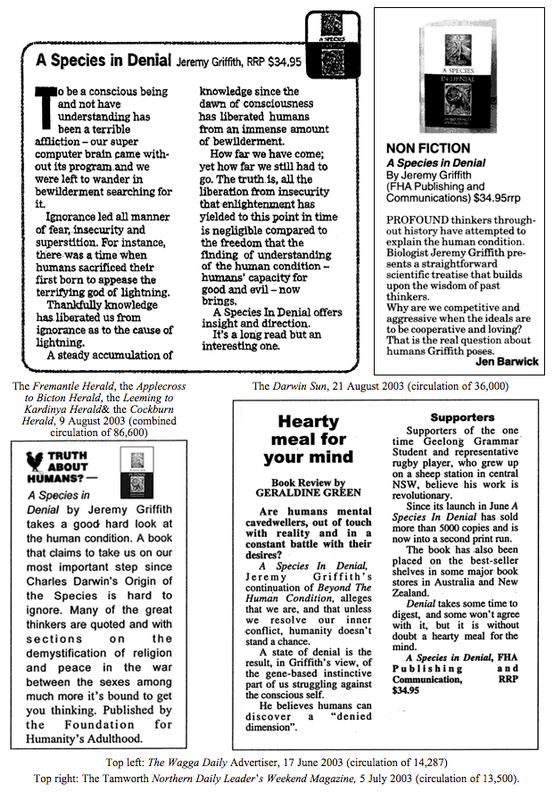
The Darwin Sun, 21 August 2003 (circulation of 36,000)

The Fremantle Herald, the Applecross to Bicton Herald, the Leeming to Kardinya Herald & the Cockburn Herald, 9 August 2003 (combined circulation of 86,600)
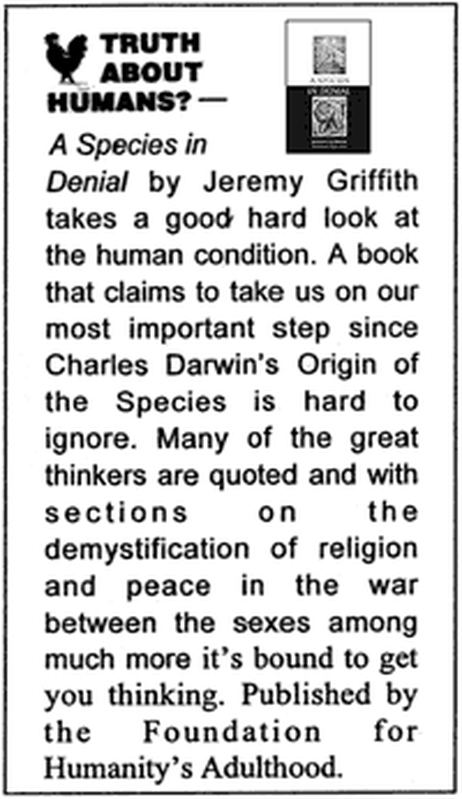
The Wagga Daily Advertiser, 17 June 2003 (circulation of 14,287)
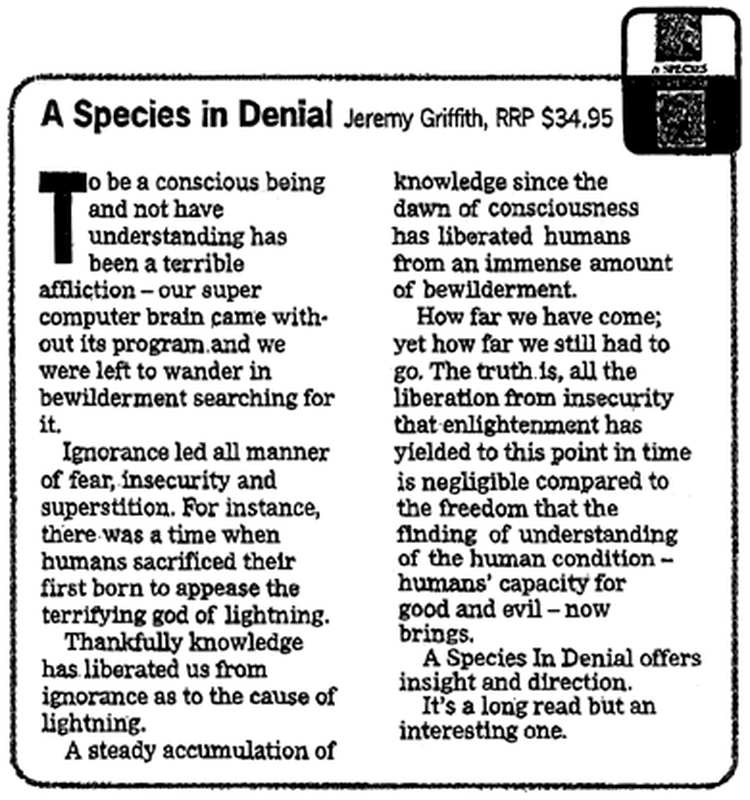
The Tamworth Northern Daily Leader’s Weekend Magazine, 5 July 2003 (circulation of 13,500).