

Page 77 of
PDF Version Is there a God?
Written by Australian biologist Jeremy Griffith, 2011
Is there a God? Is God real? Yes, BUT until we could explain our seemingly-‘unGodly’, ‘good-and-evil’-afflicted HUMAN CONDITION all we could cope with was an abstract, deity-in-the-clouds version of ‘God’!
The impasse has been that until we could explain our divisive, competitive, selfish and aggressive human condition we couldn’t afford to demystify ‘God’ and admit the truth that ‘God’ is our personification of the Negative-Entropy-driven, ordering, integrative, cooperative, selfless and loving theme or purpose or meaning of existence! Yes, we couldn’t very well confront ‘God’ while we couldn’t explain why we have seemingly been so ‘unGodly’!
MOST WONDERFULLY, however, biology is now finally able to provide the dreamed-of, exonerating, ‘good-and-evil’-reconciling, ‘burden-of-guilt’-lifting, psychologically rehabilitating explanation of the human condition—thus making it safe to demystify ‘God’ as Integrative Meaning. (And it should be mentioned that this explanation of our species’ deeply psychologically troubled, competitive, selfish and aggressive condition is not the psychosis-avoiding, trivialising, dishonest account of it that the biologist E.O. Wilson has put forward in his theory of Eusociality, but the psychosis-addressing-and-solving, real explanation of it.)
Before presenting the all-important, reconciling, psychologically rehabilitating and thus human-race-transforming, real explanation of the human condition, the following scientific explanation of ‘God’ makes it very clear why it hasn’t been possible—until now—to end the mystery of ‘Is there a God?’, ‘Is God real?’ and ‘Where is God?’
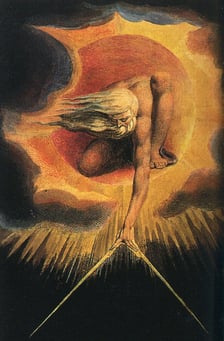
William Blake’s Ancient of Days (1794)
The world’s greatest physicists, Stephen Hawking and Albert Einstein, have said, respectively, that ‘The overwhelming impression is of order…[in] the universe’ (‘The Time of His Life’, Gregory Benford, Sydney Morning Herald, 28 Apr. 2002), and that ‘behind everything is an order’ (Einstein Revealed, PBS, 1997). Yes, this ‘order’ IS apparent everywhere. Over the eons a chaotic universe organised itself into stars, planets and galaxies. Here on Earth, atoms became ordered or integrated to form molecules → which in turn integrated to form compounds → virus-like organisms → single-celled organisms → multicellular organisms → and then societies of multicellular organisms. Overall, what is happening on Earth is that matter is becoming ordered into larger wholes. So the theme or purpose or meaning of existence is the ordering or integration or complexification of matter, a process that is driven by the physical law of Negative Entropy. ‘Holism’, which the dictionary defines as ‘the tendency in nature to form wholes’ (Concise Oxford Dictionary, 5th edn, 1964), and ‘teleology’, which is defined as ‘the belief that purpose and design are a part of nature’ (Macquarie Dictionary, 3rd edn, 1998), are both terms that recognise this integrative ‘tendency’.
Page 78 of
PDF Version HOWEVER, the great problem with this truth of the integrative meaning of life is that for a larger whole to form and hold together the parts of that whole must consider the welfare of the whole above their own welfare—put simply, selfishness is divisive or disintegrative while selflessness is integrative. So consider-others-above-yourself, altruistic, unconditional selflessness is the underlying theme of existence. It’s the glue that holds the world together and what we really mean by the term ‘love’. Indeed, if we consider religious terminology, the old Christian word for love was ‘caritas’, which means charity or giving or selflessness; see Col. 3:14, 1 Cor. 13:1—13, 10:24, and John 15:13. Of these biblical references, Colossians 3:14 perfectly summarises the integrative significance of love: ‘And over all these virtues put on love, which binds them all together in perfect unity.’ In John 15:13 we also see that Christ emphasised the unconditionally selfless significance of the word ‘love’ when he said, ‘Greater love has no-one than this, that one lay down his life for his friends.’ BUT admitting and accepting this truth of the integrative cooperative, unconditionally selfless, loving meaning of existence left humans feeling unbearably condemned as bad, evil or unworthy for our divisive competitive, selfish and aggressive, seemingly-unloving behaviour. ONLY when we could truthfully explain the good reason WHY we humans have not been ideally behaved—truthfully explain the human condition no less, which fortunately we now can—would it be psychologically safe to confront, admit and accept that the meaning of life is to be integrative, cooperative, selfless and loving.
To make the connection between this truth about the meaning of life and the question ‘What is God?’, more of what Hawking and Einstein said on the subject needs to be included because we will see that the concept of ‘God’ is actually our personification of this truth of Integrative Meaning. Hawking: ‘The overwhelming impression is of order. The more we discover about the universe, the more we find that it is governed by rational laws. If one liked, one could say that this order was the work of God. Einstein thought so…We could call order by the name of God’ (‘The Time of His Life’, Gregory Benford, Sydney Morning Herald, 28 Apr. 2002); and, ‘I would use the term God as the embodiment of the laws of physics’ (Master of the Universe, BBC, 1989). Einstein: ‘over time, I have come to realise that behind everything is an order that we glimpse only indirectly [because it’s unbearably confronting/condemning!]. This is religiousness. In this sense, I am a religious man’ (Einstein Revealed, PBS, 1997). Since we can now understand that unconditional selflessness or ‘love’ is an aspect of this ordering, Godly theme of existence, then the Biblical reference ‘God is love’ (1 John 4:8, 16) is an accurate answer to the question ‘Who is God?’ or ‘What is God?’ Yes, regardless of the various names of God used by the different faiths, the most central of the attributes of God is that God is love. And we can now also understand that monotheism, the belief that there is only one God, was correct—the integrative theme or meaning to existence, or ‘God’, is the one all-dominating and all-pervading universal truth about our world. So in terms of the questions ‘What is God?’ and ‘Where is God?’, ‘God’ is Integrative Meaning—which is everywhere!
So, in being competitive, selfish and aggressive—in fact, so ruthlessly competitive, selfish and brutal that human life has become all but unbearable and we have nearly destroyed our own planet—we humans were apparently out-of-step with ‘the work of God’, at odds with ‘God’, and therefore seemingly not just bad and worthless, but defiling, guilty, sinful and even evil beings!! No wonder we needed the concept of ‘God’ to remain safely abstract and undefined—that we have been, as we say, ‘God-fearing’—in fact, God-revering to the point of being God-worshipping—not God-confronting. As the philosopher Page 79 of
PDF Version Nikolai Berdyaev has written, ‘Man’s fear of God is his fear of himself, of the yawning abyss of non-being in his own nature’ (The Destiny of Man, 1931, tr. N. Duddington, 1960, p.41).
It is very apparent then why it hasn’t been possible, until now, to scientifically end the mystery of is there a God—we haven’t been able to face the answer! The famous psychoanalyst Carl Jung was referring to the terrifying subject of our seemingly-‘unGodly’ condition when he wrote that ‘When it [our shadow] appears…it is quite within the bounds of possibility for a man to recognize the relative evil of his nature, but it is a rare and shattering experience for him to gaze into the face of absolute evil’ (Aion in The Collected Works of C.G. Jung, Vol. 9/2, p.10). Yes, the ‘face of absolute evil’ is the ‘shattering’ possibility—if we allowed our minds to think about it—that we humans might indeed be a terrible mistake!
When the scientist-philosopher Teilhard de Chardin wrote, ‘I can see a direction and a line of progress for life, a line and a direction which are in fact so well marked that I am convinced their reality will be universally admitted by the science of tomorrow’ (The Phenomenon of Man, 1938, p.142), he was recognising firstly how obvious the truth of the integrative, order-of-matter-developing theme of existence really is; and, secondly, that this truth of the integrative ‘direction’ or theme or purpose or meaning of existence wouldn’t be able to be ‘admitted’ until the human-condition-resolved ‘science of tomorrow’ emerged, which relievingly it now has. ‘Yesterday’s’ scientists avoided the overarching, truthful whole view of the integrative meaning of existence and the issue of the human condition it raised and instead adopted a reduced view that only focused down on to the details about the mechanisms of the workings of our world—they have been what’s called ‘reductionist’ and ‘mechanistic’, not ‘teleological’ and ‘holistic’—and the contrivance they developed to avoid the truth of Integrative Meaning was to assert that there is no direction or meaning to existence and that change is random. Furthermore, to avoid religion’s acknowledgement of Integrative Meaning (albeit an indirect and abstract acknowledgement in the form of the concept of ‘God’) ‘yesterday’s’ scientists claimed that religion and science were two totally unrelated realms—to the point that E.O. Wilson has said, ‘I take a very strong stance against the mingling of religion and science’ (National Geographic Magazine, May 2006). Of course, as the Nobel Prize-winning physicist Charles H. Townes truthfully admitted, ‘they [religion and science] both represent man’s efforts to understand his universe and must ultimately be dealing with the same substance. As we understand more in each realm, the two must grow together…converge they must’ (‘The Convergence of Science and Religion’, Zygon, Vol.1 No.3, 1966).
Indeed, the great hope implicit in the reductionist, mechanistic approach was that by finding understanding of the mechanisms of the workings of our world its practitioners would at least be assembling the means by which the human condition might one day be able to be explained—and that is exactly what they achieved. As will be described shortly, through the gradual accumulation of knowledge about the mechanisms of the workings of our world, scientists found understanding of the difference in the way genes and nerves function, which is the key insight that at last made it possible to explain the human condition. (Again, it has to be stressed that this explanation is not the psychosis-avoiding, trivialising, dishonest account of the human condition that E.O. Wilson has put forward in his theory of Eusociality, but the psychosis-addressing-and-solving, truthful, real explanation of it.)
So it is only now that the human condition has been truthfully explained that de Chardin’s integrative-‘direction’-or-theme-or-purpose-or-meaning-acknowledging ‘science of tomorrow’ can emerge. And it is also only now that the integrative ideals and our lack of Page 80 of
PDF Version compliance with them can be reconciled and religion and science ‘converge’. Science has finally enabled us to find proof of God! Furthermore, finding understanding of our less-than-ideally-behaved human condition is the crucial insight we needed to psychologically rehabilitate the human race. Carl Jung was forever saying that ‘wholeness for humans depends on the ability to own their own shadow’ because he recognised that only finding understanding of our dark side could end our underlying insecurity about our fundamental goodness and worth as humans and, in so doing, make us ‘whole’. Yes, it is only now that we can truthfully explain the human condition that we can understand and thus heal that divisive competitive, selfish and aggressive, seemingly-‘unGodly’ condition. And yes, this reconciling truthful explanation of the human condition that is about to be presented at last allows us to understand that while we may have appeared ‘unGodly’, that was actually not the case, which means that, in a full or greater sense, ‘God’ is compassionate—that ‘God is good’; in fact, ‘God is great’; that our ‘faith in God’, especially in the ‘grace of God’, that ‘God loves you’, was justified! As we are going to see, the plea ‘God help me’ is now finally able to be satisfied by a full explanation, understanding and appreciation of what ‘the love of God’ actually is. So many of our recognised aspects of ‘God’ are now at last able to be understood. Overall, our ability to understand that God is Integrative Meaning means we can now end the mystery of ‘What is God?’ and ‘Is God real?’!
So, what is this WONDERFUL breakthrough, liberating, psychosis-addressing-and-solving, truthful biological explanation of the human condition that finally allows us to safely acknowledge that ‘God’ is Integrative Meaning. WHY ARE humans competitive, selfish, aggressive when the ideals of life are clearly to be cooperative, selfless and loving?
Certainly, we have invented excuses to justify our species’ seemingly-‘unGodly’ competitive, selfish and aggressive human behaviour, the main one being that we have savage animal instincts that make us fight and compete for food, shelter, territory and a mate. Of course, this ‘explanation’, which has been put forward in the biological theories of Social Darwinism, Sociobiology, Evolutionary Psychology, Multilevel Selection and E.O. Wilson’s Eusociality and basically argues that ‘genes are competitive and selfish and that’s why we are’, can’t be the real explanation for our competitive, selfish and aggressive behaviour. Firstly, it overlooks the fact that our human behaviour involves our unique fully conscious thinking mind. Descriptions like egocentric, arrogant, deluded, artificial, hateful, mean, immoral, alienated, etc, all imply a consciousness-derived, psychological dimension to our behaviour. The real issue—the psychological problem in our thinking minds that we have suffered from—is the dilemma of our human condition, the issue of our species’ ‘good-and-evil’-afflicted, less-than-ideal, even ‘fallen’ or corrupted, state. We humans suffer from a consciousness-derived, psychological HUMAN CONDITION, not an instinct-controlled animal condition—our condition is unique to us fully conscious humans. (A brief description of the theories of Social Darwinism, Sociobiology, Evolutionary Psychology, Multilevel Selection and Eusociality that blame our divisive behaviour on savage instincts rather than on a consciousness-derived psychosis is presented in the What is Science? article in this, The Book of Real Answers to Everything!, with the complete account provided in the freely-available, online book Freedom: Expanded Book 1.)
The second reason the savage-instincts-in-us excuse can’t possibly be the real explanation for our divisive, selfish and aggressive behaviour is that it overlooks the fact Page 81 of
PDF Version that we humans have altruistic, cooperative, loving moral instincts—what we recognise as our ‘conscience’—and these moral instincts in us that are aligned to the integrative, selfless, loving meaning of life are not derived from reciprocity, from situations where you only do something for others in return for a benefit from them, as Evolutionary Psychologists would have us believe. And nor are they derived from warring with other groups of humans as advocates of the theory of Eusociality would have us believe. No, we have an unconditionally selfless, fully altruistic, truly loving, universally-considerate-of-others-not-competitive-with-other-groups, genuinely moral conscience. Our original instinctive state was the opposite of being competitive, selfish and aggressive: it was fully cooperative, selfless and loving. So, not only is there a God, our species’ original instinctive alignment WAS TO the integrative, truly loving, ‘Godly’ state; as William Wordsworth wrote in his great poem, Intimations of Immortality, ‘trailing clouds of glory do we come, from God, who is our home’. (How we humans acquired unconditionally selfless moral instincts when it would seem that an unconditionally selfless, fully altruistic trait is going to self-eliminate and thus not ever be able to become established in a species is briefly explained in the above-mentioned What is Science? article, and more fully explained in chapter 5 of FREEDOM—however, the point being made here is that the savage-instincts-in-us excuse is completely inconsistent with the fact that we have genuine and entirely moral instincts, NOT savage instincts. Charles Darwin recognised the difference in our moral nature when he said that ‘the moral sense affords the best and highest distinction between man and the lower animals’ (The Descent of Man, 1871, p.495).)
So, what is the truthful, human-condition-addressing rather than human-condition-avoiding, biological explanation of our species’ present seemingly-highly-imperfect, competitive, selfish and aggressive behaviour? The answer begins with an analysis of consciousness.
Very briefly, nerves were originally developed for the coordination of movement in animals, but, once developed, their ability to store impressions—which is what we refer to as ‘memory’—gave rise to the potential to develop understanding of cause and effect. If you can remember past events, you can compare them with current events and identify regularly occurring experiences. This knowledge of, or insight into, what has commonly occurred in the past enables you to predict what is likely to happen in the future and to adjust your behaviour accordingly. Once insights into the nature of change are put into effect, the self-modified behaviour starts to provide feedback, refining the insights further. Predictions are compared with outcomes and so on. Much developed, and such refinement occurred in the human brain, nerves can sufficiently associate information to reason how experiences are related, learn to understand and become CONSCIOUS of, or aware of, or intelligent about, the relationship between events that occur through time. Thus consciousness means being sufficiently aware of how experiences are related to attempt to manage change from a basis of understanding.
What is so significant about this process is that once our nerve-based learning system became sufficiently developed for us to become conscious and able to effectively manage events, our conscious intellect was then in a position to wrest control from our gene-based learning system’s instincts, which, up until then, had been controlling our lives. Basically, once our self-adjusting intellect emerged it was capable of taking over the management of our lives from the instinctive orientations we had acquired through the natural selection of genetic traits that adapted us to our environment.
Page 82 of
PDF Version HOWEVER, it was at this juncture, when our conscious intellect challenged our instincts for control, that a terrible battle broke out between our instincts and intellect, the effect of which was the extremely competitive, selfish and aggressive state that we call the human condition.
To elaborate, when our conscious intellect emerged it was neither suitable nor sustainable for it to be orientated by instincts—it had to find understanding to operate effectively and fulfil its great potential to manage life. However, when our intellect began to exert itself and experiment in the management of life from a basis of understanding, in effect challenging the role of the already established instinctual self, a battle unavoidably broke out between the instinctive self and the newer conscious self.
Our intellect began to experiment in understanding as the only means of discovering the correct and incorrect understandings for managing existence, but the instincts—being in effect ‘unaware’ or ‘ignorant’ of the intellect’s need to carry out these experiments—‘opposed’ any understanding-produced deviations from the established instinctive orientations: they ‘criticised’ and ‘tried to stop’ the conscious mind’s necessary search for knowledge. To illustrate the situation, imagine what would happen if we put a fully conscious mind on the head of a migrating bird. The bird is following an instinctive flight path acquired over thousands of generations of natural selection, but it now has a conscious mind that needs to understand how to behave, and the only way it can acquire that understanding is by experimenting in understanding—for example, thinking, ‘I’ll fly down to that island and have a rest.’ But such a deviation from the migratory flight path would naturally result in the instincts resisting the deviation, leaving the conscious intellect in a serious dilemma: if it obeys its instincts it will not feel ‘criticised’ by its instincts but neither will it find knowledge. Obviously, the intellect could not afford to give in to the instincts, and unable to understand and thus explain why its experiments in self-adjustment were necessary, the conscious intellect had no way of refuting the implicit criticism from the instincts even though it knew it was unjust. Until the conscious mind found the redeeming understanding of why it had to defy the instincts (namely the scientific understanding of the difference in the way genes and nerves process information, that one is an orientating learning system while the other is an insightful learning system), the intellect was left having to endure a psychologically distressed, upset condition, with no choice but to defy that opposition from the instincts. The only forms of defiance available to the conscious intellect were to attack the instincts’ unjust criticism, try to deny or block from its mind the instincts’ unjust criticism, and attempt to prove the instincts’ unjust criticism wrong. In short—and to return to our human situation because we were the species that acquired the fully conscious mind—the psychologically upset angry, alienated and egocentric human-condition-afflicted state appeared. Our ‘conscious thinking self’, which is the dictionary definition of ‘ego’, became ‘centred’ or focused on the need to justify itself. We became ego-centric, self-centred or selfish, preoccupied with aggressively competing for opportunities to prove we are good and not bad—we unavoidably became selfish, aggressive and competitive.
What is so exonerating, rehabilitating and healing about this explanation of the human condition is that we can finally appreciate that there was a very good reason for our seemingly-‘unGodly’ angry, alienated and egocentric behaviour—in fact, we can now see why we have not just been ego-centric, but ego-infuriated, even ego-gone-mad-with-murderous-anger for having to live with so much unjust criticism. We can now see that Page 83 of
PDF Version our conscious mind was NOT the evil villain it has so long been portrayed as—such as in the Bible where Adam and Eve are demonised and ‘banished…from the Garden of Eden’ (Gen. 3:23) of our original innocent, all-loving, ‘clouds of glory’ ‘home’ for taking the ‘fruit…from the tree of knowledge’ (ibid. 3:3, 2:17). No, science has finally enabled us to lift the so-called ‘burden of guilt’ from the human race; in fact, to understand that we thinking, ‘knowledge’-finding, conscious humans are actually nothing less than the heroes of the story of life on Earth! This is because our fully conscious mind is surely nature’s greatest invention and to have had to endure the torture of being unjustly condemned as evil for so long (the anthropological evidence indicates we humans have been fully conscious for some two million years) must make us the absolute heroes of the story of life on Earth. Finally, God and man, religion and science, our instinct and intellect, the integrative meaning of life and the inconsistency of our behaviour with that meaning, are all reconciled. Our ‘faith in God’, especially in the ‘grace of God’, has been justified!
And BEST OF ALL, because this explanation of the human condition is redeeming and thus rehabilitating, all our upset angry, egocentric and alienated behaviour now subsides, bringing about the complete TRANSFORMATION OF THE HUMAN RACE—and importantly, understanding of the human condition doesn’t condone ‘bad’ behaviour, it heals and by so doing ends it. From being competitive, selfish and aggressive, humans return to being cooperative, selfless and loving. Our round of departure has ended. The poet T.S. Eliot wonderfully articulated our species’ journey from an original innocent, yet ignorant, state to a ‘fallen’, corrupted, seemingly ‘unGodly’, psychologically upset state, and back to an uncorrupted, integrative, but this time enlightened, state when he wrote, ‘We shall not cease from exploration and the end of all our exploring will be to arrive where we started and know the place for the first time’ (Little Gidding, 1942).
Resolving the underlying insecurity in our natures allows us to answer all our questions about God and, most importantly, live in accordance with the integrative meaning of life—yes, finding the exonerating, redeeming understanding of our dark, troubled, psychologically upset, human-condition-afflicted existence finally enables the human race to be healed and thus TRANSFORMED—it makes us ‘whole’ again, as Jung said it would. To quote Professor Harry Prosen, a former president of the Canadian Psychiatric Association, on this dreamed-of, greatest of all breakthroughs in science: ‘I have no doubt this biological explanation of the human condition is the holy grail of insight we have sought for the psychological rehabilitation of the human race’ (FREEDOM, 2016, Introduction).
As just demonstrated, with understanding of the human condition
found ALL the great issues finally become explainable.
See also: Human condition – What is science? – What is love? – Soul – Conscience
– Good vs Evil – What is the meaning of life? – Our ego and egocentric lives –
How can we save the world? – Consciousness – Human nature –
Why do people lie? – Why do we fall in love?
For a book of these explanations to keep or give to others, print
The Book of Real Answers to Everything! by Jeremy Griffith,
featuring a Foreword by Professor Harry Prosen, at
www.humancondition.com/real-answers
and/or
Page 84 of
PDF Version Watch videos on the biological explanation of the human condition and the
dreamed-of TRANSFORMATION of the human race that it brings about
at www.humancondition.com
and/or
Read FREEDOM, the definitive book on the world-transforming explanation of the
human condition, specifically chapter 4 for the detailed answer to ‘Is there a God?’,
at www.humancondition.com/freedom