

Page 64 of
PDF Version Good vs Evil
Written by Australian biologist Jeremy Griffith, 2011
How are we to understand and resolve the historic battle of so-called ‘good vs evil’ in the world? Basically, how are we to make sense of human behaviour, specifically the dark side of human nature? In fact, are we ever going to be able to explain the HUMAN CONDITION? And, more particularly, can we humans ever become truly moral beings?
MOST WONDERFULLY, the answer to these last two core questions about human existence is YES! Biology is now, at last, able to provide the dreamed-of, exonerating, ‘good vs evil’-reconciling, ‘burden-of-guilt’-lifting and thus psychologically healing, HUMAN-RACE-TRANSFORMING explanation of our ‘good and evil’-conflicted human condition! (And it should be mentioned that this explanation of our species’ deeply psychologically troubled condition is not the psychosis-avoiding, trivialising, dishonest account of it that the biologist E.O. Wilson has put forward in his theory of Eusociality, but the psychosis-addressing-and-solving, real explanation of it.)
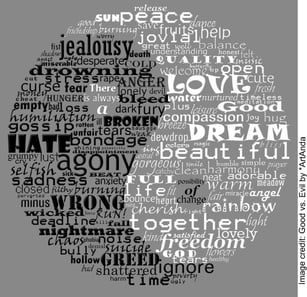
The famous psychoanalyst Carl Jung was forever saying that ‘wholeness for humans depends on the ability to own their own shadow’ because he recognised that only finding understanding of our dark side could end the underlying insecurity in us humans about our fundamental goodness and worth, and, in so doing, make us ‘whole’. The pre-eminent philosopher Sir Laurens van der Post was making the same point when he said that ‘True love is love of the difficult and unlovable’ (Journey Into Russia, 1964, p.145) and that ‘Only by understanding how we were all a part of the same contemporary pattern [of wars, cruelty, greed and indifference] could we defeat those dark forces with a true understanding of their nature and origin’ (Jung and the Story of Our Time, 1976, p.24).
Yes, the agonising, underlying, core, real question in all of human life has been the issue of our seemingly-imperfect, ‘good vs evil’-conflicted, even ‘fallen’ or corrupted, so-called HUMAN CONDITION. Are humans good or are we possibly the terrible mistake that all the evidence seems to unequivocally indicate we might be? While it’s undeniable that humans are capable of great love, we also have an unspeakable history of brutality, rape, torture, murder and war—despite all our marvellous accomplishments, we humans have been the most ferocious and destructive force that has ever lived on Earth. And it’s this conflicted situation that we needed to find understanding of—how are we to understand and by so doing resolve the battle of ‘good vs evil’ in the human make-up? Or, to use the Page 65 of
PDF Version Eastern description of the fundamental poles involved in the human condition—how are we to reconcile our ‘Yin and Yang’? Yes, what is the biological explanation for ‘sin’, as our far-from-ideal behaviour has historically been termed? What is ‘the origin of sin’, and, more particularly, how can it be ameliorated? Even in our everyday behaviour, why have we humans been so competitive, selfish and aggressive when clearly the ideals of life are to be the complete opposite, namely cooperative, selfless and loving? In fact, why are we so ruthlessly competitive, selfish and brutal that human life has become all but unbearable and we have nearly destroyed our own planet?!
Unable—until now—to truthfully answer this deepest and darkest of all questions about the origin and meaning of our ‘good vs evil’, human-condition-afflicted existence, we learnt to avoid the whole depressing subject—so much so, in fact, that the human condition has been described as ‘the personal unspeakable’, and as ‘the black box inside of humans they can’t go near’. Indeed, Carl Jung was referring to the terrifying subject of our ‘good vs evil’-embattled human condition when he wrote that ‘When it [our shadow] appears…it is quite within the bounds of possibility for a man to recognize the relative evil of his nature, but it is a rare and shattering experience for him to gaze into the face of absolute evil’ (Aion in The Collected Works of C.G. Jung, Vol. 9/2, p.10). Yes, the ‘face of absolute evil’ in our ‘nature’ is the ‘shattering’ possibility—if we allowed our minds to think about it—that we humans might indeed be a terrible mistake! The great philosopher Nikolai Berdyaev certainly wasn’t exaggerating when, in describing both the agony of our ‘good vs evil’-afflicted state or predicament and the need to resolve it, he wrote that ‘There is a deadly pain in the very distinction of good and evil, of the valuable and the worthless. We cannot rest in the thought that that distinction is ultimate…we cannot bear to be faced with the distinction between good and evil for ever’ (The Destiny of Man, 1931, p.15).
So, what is the dreamed-of, breakthrough, psychosis-addressing-and-solving, truthful, real biological explanation of the human condition that at last allows us to acknowledge, understand and resolve our historic ‘good vs evil’-conflicted existence?
Certainly, we have invented excuses to justify our species’ seemingly-imperfect competitive, selfish and aggressive behaviour, the main one being that we have savage animal instincts that make us fight and compete for food, shelter, territory and a mate. Of course, this ‘explanation’, which has been put forward in the biological theories of Social Darwinism, Sociobiology, Evolutionary Psychology, Multilevel Selection and E.O. Wilson’s Eusociality and basically argues that ‘genes are competitive and selfish and that’s why we are’, can’t be the real explanation for our competitive, selfish and aggressive behaviour. Firstly, it overlooks the fact that our human behaviour involves our unique fully conscious thinking mind. Descriptions like egocentric, arrogant, deluded, artificial, hateful, mean, immoral, sinful, alienated, etc, all imply a consciousness-derived, psychological dimension to our behaviour. The real issue—the psychological problem in our thinking minds that we have suffered from—is the dilemma of our human condition, the issue of our species’ ‘good and evil’/‘yin and yang’-afflicted, less-than-ideal, even ‘fallen’ or corrupted, state. We humans suffer from a consciousness-derived, psychological HUMAN CONDITION, not an instinct-controlled animal condition—our condition is unique to us fully conscious humans. (A brief description of the theories of Social Darwinism, Page 66 of
PDF Version Sociobiology, Evolutionary Psychology, Multilevel Selection and Eusociality that blame our divisive behaviour on savage instincts rather than on a consciousness-derived psychosis is presented in the What is Science? article in this, The Book of Real Answers to Everything!, with the complete account provided in the freely-available, online book Freedom: Expanded Book 1.)
The second reason the savage-instincts-in-us excuse can’t possibly be the real explanation for our divisive, selfish and aggressive behaviour is that it overlooks the fact that we humans have altruistic, cooperative, loving moral instincts—what we recognise as our ‘conscience’—and these moral instincts in us are not derived from reciprocity, from situations where you only do something for others in return for a benefit from them, as Evolutionary Psychologists would have us believe. And nor are they derived from warring with other groups of humans as advocates of the theory of Eusociality would have us believe. No, we have an unconditionally selfless, fully altruistic, truly loving, universally-considerate-of-others-not-competitive-with-other-groups, genuinely moral conscience. Our original instinctive state was the opposite of being competitive, selfish and aggressive: it was fully cooperative, selfless and loving. (How we humans acquired unconditionally selfless moral instincts when it would seem that an unconditionally selfless, fully altruistic trait is going to self-eliminate and thus not ever be able to become established in a species is briefly explained in the above-mentioned What is Science? article, and more fully explained in chapter 5 of FREEDOM—however, the point being made here is that the savage-instincts-in-us excuse is completely inconsistent with the fact that we have genuine and entirely moral instincts, NOT savage instincts. Charles Darwin recognised the difference in our moral nature when he said that ‘the moral sense affords the best and highest distinction between man and the lower animals’ (The Descent of Man, 1871, p.495).)
So, what is the truthful, human-condition-addressing rather than human-condition-avoiding, biological explanation of our ‘good vs evil’-conflicted behaviour? The answer begins with an analysis of consciousness.
Very briefly, nerves were originally developed for the coordination of movement in animals, but, once developed, their ability to store impressions—which is what we refer to as ‘memory’—gave rise to the potential to develop understanding of cause and effect. If you can remember past events, you can compare them with current events and identify regularly occurring experiences. This knowledge of, or insight into, what has commonly occurred in the past enables you to predict what is likely to happen in the future and to adjust your behaviour accordingly. Once insights into the nature of change are put into effect, the self-modified behaviour starts to provide feedback, refining the insights further. Predictions are compared with outcomes and so on. Much developed, and such refinement occurred in the human brain, nerves can sufficiently associate information to reason how experiences are related, learn to understand and become CONSCIOUS of, or aware of, or intelligent about, the relationship between events that occur through time. Thus consciousness means being sufficiently aware of how experiences are related to attempt to manage change from a basis of understanding.
What is so significant about this process is that once our nerve-based learning system became sufficiently developed for us to become conscious and able to effectively manage events, our conscious intellect was then in a position to wrest control from our gene-based learning system’s instincts, which, up until then, had been controlling our lives. Basically, once our self-adjusting intellect emerged it was capable of taking over the management of Page 67 of
PDF Version our lives from the instinctive orientations we had acquired through the natural selection of genetic traits that adapted us to our environment.
HOWEVER, it was at this juncture, when our conscious intellect challenged our instincts for control, that a terrible battle broke out between our instincts and intellect, the effect of which was the extremely competitive, selfish and aggressive state that we call the human condition.
To elaborate, when our conscious intellect emerged it was neither suitable nor sustainable for it to be orientated by instincts—it had to find understanding to operate effectively and fulfil its great potential to manage life. However, when our intellect began to exert itself and experiment in the management of life from a basis of understanding, in effect challenging the role of the already established instinctual self, a battle unavoidably broke out between the instinctive self and the newer conscious self.
Our intellect began to experiment in understanding as the only means of discovering the correct and incorrect understandings for managing existence, but the instincts—being in effect ‘unaware’ or ‘ignorant’ of the intellect’s need to carry out these experiments—‘opposed’ any understanding-produced deviations from the established instinctive orientations: they ‘criticised’ and ‘tried to stop’ the conscious mind’s necessary search for knowledge. To illustrate the situation, imagine what would happen if we put a fully conscious mind on the head of a migrating bird. The bird is following an instinctive flight path acquired over thousands of generations of natural selection, but it now has a conscious mind that needs to understand how to behave, and the only way it can acquire that understanding is by experimenting in understanding—for example, thinking, ‘I’ll fly down to that island and have a rest.’ But such a deviation from the migratory flight path would naturally result in the instincts resisting the deviation, leaving the conscious intellect in a serious dilemma: if it obeys its instincts it will not feel ‘criticised’ by its instincts but neither will it find knowledge. Obviously, the intellect could not afford to give in to the instincts, and unable to understand and thus explain why its experiments in self-adjustment were necessary, the conscious intellect had no way of refuting the implicit criticism from the instincts even though it knew it was unjust. Until the conscious mind found the redeeming understanding of why it had to defy the instincts (namely the scientific understanding of the difference in the way genes and nerves process information, that one is an orientating learning system while the other is an insightful learning system), the intellect was left having to endure a psychologically distressed, upset condition, with no choice but to defy that opposition from the instincts. The only forms of defiance available to the conscious intellect were to attack the instincts’ unjust criticism, try to deny or block from its mind the instincts’ unjust criticism, and attempt to prove the instincts’ unjust criticism wrong. In short—and to return to our human situation because we were the species that acquired the fully conscious mind—the psychologically upset angry, alienated and egocentric ‘good vs evil’-afflicted state appeared. Our ‘conscious thinking self’, which is the dictionary definition of ‘ego’, became ‘centred’ or focused on the need to justify itself. We became ego-centric, self-centred or selfish, preoccupied with aggressively competing for opportunities to prove we are good and not bad—we unavoidably became selfish, aggressive and competitive. Regarding the so-called Seven Deadly Sins of lust, anger, pride, envy, covetousness, gluttony and sloth, they are simply different manifestations of the three fundamental aspects of our upset of anger, egocentricity and alienation.
Page 68 of
PDF Version What is so exonerating, rehabilitating and healing about this explanation of the human condition is that we can finally appreciate that there was a very good reason for our angry, alienated and egocentric behaviour—in fact, we can now see why we have not just been ego-centric, but ego-infuriated, even ego-gone-mad-with-murderous-anger for having to live with so much unjust criticism. We can now see that our conscious mind was NOT the evil villain it has so long been portrayed as—such as in the Bible where Adam and Eve are demonised and ‘banished…from the Garden of Eden’ (Gen. 3:23) of our original innocent, all-loving, moral state for taking the ‘fruit…from the tree of knowledge’ (ibid. 3:3, 2:17). No, science has finally enabled us to lift the so-called ‘burden of guilt’ from the human race; in fact, to understand that we thinking, ‘knowledge’-finding, conscious humans are actually nothing less than the heroes of the story of life on Earth! This is because our fully conscious mind is surely nature’s greatest invention and to have had to endure the torture of being unjustly condemned as evil for so long (the anthropological evidence indicates we humans have been fully conscious for some two million years) must make us the absolute heroes of the story of life on Earth.
And BEST OF ALL, because this explanation of our deeply troubled, ‘good vs evil’-conflicted human condition is redeeming and thus rehabilitating, all our upset angry, egocentric and alienated behaviour now subsides, bringing about the complete TRANSFORMATION OF THE HUMAN RACE from a ‘good vs evil’-troubled state to a ‘good vs evil’-reconciled state. (Importantly, understanding of the human condition doesn’t condone ‘bad’ behaviour, it heals and by so doing ends it.) From being competitive, selfish and aggressive, humans return to being cooperative, selfless and loving. Our round of departure has ended. The poet T.S. Eliot wonderfully articulated our species’ journey from an original innocent, yet ignorant, state, to a psychologically upset ‘fallen’, corrupted state, and back to an uncorrupted, but this time enlightened, state when he wrote, ‘We shall not cease from exploration and the end of all our exploring will be to arrive where we started and know the place for the first time’ (Little Gidding, 1942).
Yes, finding the exonerating, redeeming understanding of our dark, troubled, psychologically upset, human-condition-afflicted existence finally enables the human race to be healed and thus TRANSFORMED—it makes us ‘whole’ again, as Jung said it would. To quote Professor Harry Prosen, a former president of the Canadian Psychiatric Association, on this dreamed-of, greatest of all breakthroughs in science: ‘I have no doubt this biological explanation of the human condition is the holy grail of insight we have sought for the psychological rehabilitation of the human race’ (FREEDOM, 2016, Introduction).
As just demonstrated, with understanding of the human condition
found ALL the great issues finally become explainable.
See also: Human condition – What is science? – What is love? – Soul – Conscience
– What is the meaning of life? – Is there a God? – Our ego and egocentric lives –
How can we save the world? – Consciousness – Human nature –
Why do people lie? – Why do we fall in love?
For a book of these explanations to keep or give to others, print
The Book of Real Answers to Everything! by Jeremy Griffith,
featuring a Foreword by Professor Harry Prosen, at
www.humancondition.com/real-answers
and/or
Page 69 of
PDF Version Watch videos on the biological explanation of the human condition and the
dreamed-of TRANSFORMATION of the human race that it brings about
at www.humancondition.com
and/or
Read FREEDOM, the definitive book on the world-transforming explanation
of the human condition, at www.humancondition.com/freedom