

Page 40 of
PDF Version Soul
Written by Australian biologist Jeremy Griffith, 2011
Our ‘soul’ is our species’ instinctive memory of a time when our distant ancestors lived in a cooperative, selfless, loving, innocent state—BUT that is a truth we couldn’t afford to admit until we found the clarifying, biological explanation for why we humans became competitive, selfish and aggressive; in fact, so ruthlessly competitive, selfish and brutal that human life has become all but unbearable and we have nearly destroyed our own planet!
In short, before we could acknowledge the truth about our soul we had to explain the HUMAN CONDITION—explain why the human race became corrupted, ‘fell from grace’, left the fabled ‘Garden of Eden’ of our original innocent state, or however else we like to describe the emergence of our present seemingly-highly-imperfect, soul-devastated condition.
And, MOST WONDERFULLY, biology is now finally able to provide this dreamed-of, exonerating, ‘good-and-evil’-reconciling, ‘burden-of-guilt’-lifting and thus psychologically rehabilitating EXPLANATION OF THE HUMAN CONDITION—thereby making it possible to safely admit the truth about our species’ innocent, soul-full past! (It should be mentioned that this explanation of our species’ present deeply psychologically embattled condition is not the psychosis-avoiding, trivialising, dishonest account of it that the biologist E.O. Wilson has put forward in his theory of Eusociality, but the psychosis-addressing-and-solving, real explanation of it.)
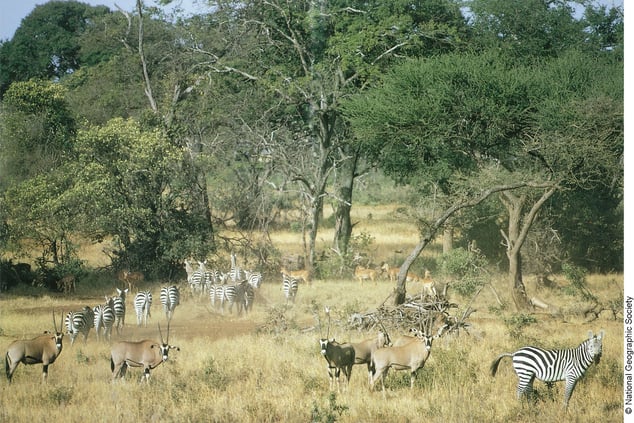
Africa—our soul’s home—the Garden of Eden
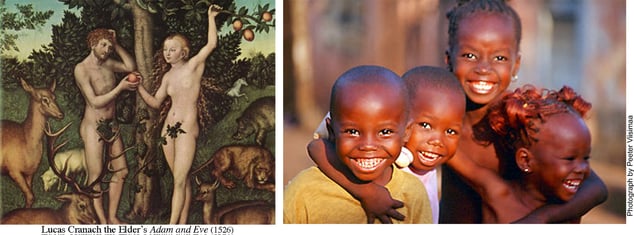
We can still see the remnants of the time when our species lived in a pre-human-condition-afflicted, innocent, soulful, Garden-of-Eden-like state in the happiness and freedom of children.
In his wonderful 1807 poem Intimations of Immortality, the poet William Wordsworth gave this rare honest description of our species’ tragic journey from its original soul-full, innocent, instinctive, moral state to its present soul-devastated, often-immoral, apparently—but, as we will see, not actually—non-ideal or, to use religious terminology, ‘unGodly’ state: ‘The Soul that rises with us, our life’s Star…cometh from afar…trailing clouds of glory do we come / From God, who is our home.’ In the poem Wordsworth described how quickly this ‘life’s Star’ of our ideal, moral, ‘God[ly]’ ‘Soul’ that is ‘with us’ when we are born becomes corrupted as we grow up in the human-condition-afflicted world of today: ‘There was a time when meadow, grove, and streams / The earth, and every common sight / To me did seem / Apparelled in celestial light / The glory and the freshness of a dream / It is not now as it hath been of yore / Turn wheresoe’er I may / By night or day / The things which I have seen I now can see no more… I know, where’er I go / That there hath past away a glory from the earth…Thou Child of Joy / Shout round me, let me hear thy shouts, thou happy Shepherd-boy! // Ye blessed Creatures…Whither is fled the visionary gleam? / Where is it now, the glory and the dream? // Our birth is but a sleep and a forgetting… Heaven lies about us in our infancy! / Shades of the prison-house begin to close / Upon the growing Boy…Forget the glories he hath known / And that imperial palace whence he came.’
Around 360 BC, the philosopher Plato also bravely acknowledged the existence within us all of an all-loving, innocent, pure, aligned-with-the-‘Godly’-ideals, original instinctive self or soul when he wrote that humans have ‘knowledge, both before and at the moment of birth…of all absolute standards…[of] beauty, goodness, uprightness, holiness…our souls exist before our birth’ (Phaedo, tr. H. Tredennick). He went on to write that ‘the soul is in every possible way more like the invariable’, which he described as ‘the pure and everlasting and immortal and changeless…realm of the absolute…[our] soul resembles the divine’ (ibid).
The philosopher Nikolai Berdyaev also truthfully acknowledged the recognition within us all of a past innocent, uncorrupted instinctive self or soul when he wrote that ‘The memory of a lost paradise, of a Golden Age, is very deep in man’ (The Destiny of Man, 1931, tr. N. Duddington, 1960, p.36); while the philosopher Jean-Jacques Rousseau also expressed what we all intuitively do know is the truth about our species’ past innocent existence when he wrote that ‘nothing is more gentle than man in his primitive state’ (The Social Contract and Discourses, 1755; tr. G.D.H. Cole, 1913, Book IV, The Origin of Inequality, p.198).
But again, while these greatest of poets and philosophers were able to acknowledge the existence of our soul, Wordsworth’s, Plato’s, Berdyaev’s and Rousseau’s inability to explain why our soul became corrupted meant their beautifully honest words ultimately Page 42 of
PDF Version left us humans feeling unbearably condemned for our present seemingly-highly-imperfect condition. In fact, trying to face the truth about our species’ present corrupted, ‘fallen’ condition without the exonerating explanation for it left humans facing the prospect of excruciating, even suicidal, depression! Such has been the extent of the real agony of the human condition! The above poets and philosophers were brave indeed!
Since the human race could not psychologically afford to face the truth that our soul is our instinctive memory of a cooperative, selfless and loving ‘Garden of Eden’ ‘Golden Age’ in our species’ past until we could explain our present corrupted, innocence-destroyed, soul-devastated competitive, selfish and aggressive condition, science has, until now, had to avoid the whole issue of what our soul is—as the psychologist Ronald Conway noted, ‘Soul is customarily suspected in empirical psychology and analytical philosophy as a disreputable entity’ (The Australian, 10 May 2000). When the need for denial is critical any excuse will do, but calling soul a ‘disreputable entity’ is a very poor excuse indeed because it is one of our most used terms and, therefore, has a very real and authentic meaning. But beyond being poor, this excuse verges on the ridiculous when we take into account the fact that our soul is actually the fundamental issue in ‘psychology’, with the word ‘psychology’ literally meaning the ‘study of the soul’, derived as it is, according to the Online Etymology Dictionary, from psyche, which comes from the Greek word psykhe, meaning ‘breath, life, soul’, and the Greek word logia, meaning ‘study of’. Yes, ‘psyche’ is another word for soul, as the Penguin Dictionary of Psychology confirms: ‘psyche: The oldest and most general use of this term is by the early Greeks, who envisioned the psyche as the soul or the very essence of life’ (1985). Also revealing is the word ‘psychiatry’, which literally means ‘soul-healing’, derived as it is from psyche (which again means soul) and the Greek word iatreia, which, according to The Encyclopedic World Dictionary, means ‘healing’. Similarly revealing of what the study of psychology is really all about is the word ‘psychosis’, which literally means ‘soul-illness’, coming as it does from psyche (which again means soul) and osis which, according to Dictionary.com, is also of Greek origin and means ‘abnormal state or condition’.
But again, despite society’s prevalent use of the term and its central role in the etymology of mental health, our denial has been such that dictionary definitions of the word ‘soul’ have also understandably followed a somewhat evasive path—for instance, the Concise Oxford Dictionary defines ‘soul’ as ‘the immaterial…moral and emotional part of man’, and as the ‘animating or essential part’ of us, while The Macquarie Dictionary describes ‘soul’ as the ‘principle of life, feeling, thought, and action in humans’, and as being ‘the spiritual part of humans regarded in its moral aspect…the seat of the feelings or sentiments’. Yes, until we could explain and thus heal our soul’s ‘abnormal state or condition’ we had no choice but to dismiss it as a ‘disreputable entity’ and try to bury its meaning in opaque references.
So, what is the reconciling, redeeming and thus psychologically rehabilitating and soul-resuscitating, truthful, real biological explanation of our present seeming-highly-imperfect, soul-devastated human condition? What is the explanation that finally makes it psychologically safe to both acknowledge that our moral soul is our instinctive memory of a cooperative, all-loving past, and explain how we acquired it in the first place?
Understandably, to avoid feeling bad and unworthy, even defiling and evil for no longer being ideally behaved and soul-full, false excuses had to be invented to justify our species’ present competitive, selfish and aggressive behaviour while the true explanation Page 43 of
PDF Version for such behaviour was still to be found—with the main excuse being that we have savage animal instincts that make us fight and compete for food, shelter, territory and a mate. While it is true that when the need for denial is critical any excuse will do, clearly this human-condition-avoiding ‘explanation’ that basically argues that ‘genes are competitive and selfish and that’s why we are’, which, as is about to be described, has been put forward in the biological theories of Sociobiology, Evolutionary Psychology, Multilevel Selection and E.O. Wilson’s Eusociality, can’t be the real explanation for our present divisive behaviour. For a start, it overlooks the fact that our human behaviour involves our unique fully conscious thinking mind. Descriptions like egocentric, arrogant, deluded, artificial, hateful, mean, immoral, alienated, etc, all imply a consciousness-derived, psychological dimension to our behaviour. The real issue—the psychological problem in our thinking minds that we have suffered from—is the dilemma of our human condition, the issue of our species’ soul-devastated, seemingly-imperfect, even ‘fallen’ or corrupted, state. We humans suffer from a consciousness-derived, psychological HUMAN CONDITION, not an instinct-controlled animal condition—our condition is unique to us fully conscious humans.
Of course, the savage-instincts-in-us excuse is also completely inconsistent with the fact that we humans have altruistic, cooperative, selfless and loving, soul-full, moral instincts—what we recognise as our ‘conscience’. Clearly then, for the human-condition-avoiding, savage-instincts-in-us excuse to be preserved, a way had to be found around this fact that our original instinctive self or soul’s orientations are to behave in an unconditionally selfless, altruistic, moral way, not in a selfish, savage way—and the way that was found was to assert that our unconditionally selfless, moral instincts are not actually selfless, but selfish. This was achieved by claiming that our instinctive self or soul’s moral conscience that causes us to behave in an altruistic way is actually a product of reciprocity, from situations frequently found in the animal world where an animal behaves selflessly on the condition it is treated selflessly in return, in which case the behaviour is still intrinsically selfish.
This reciprocity-based account of social behaviour became fully developed with the explanation put forward by the kin-selection-based theory of Sociobiology (and later Evolutionary Psychology) for situations where, for example, worker ants and bees selflessly support their respective colony and queen on the proviso that she reproduces their genes. What happened was that this situation—where individuals foster relatives or kin because they carry their genes and through supporting them they are ensuring at least some of their own genes are reproduced—was dishonestly used to dismiss humans’ selfless, moral behaviour as just another example of this reciprocal selflessness that is actually selfishness. Yes, any instinctive moral self-or-soul-inspired unconditionally, altruistic behaviour exhibited by us humans, such as charity workers caring for the poor, was said to not be genuinely altruistic behaviour but an indirect form of selfish behaviour!
To demonstrate how this reciprocity explanation has been used to supposedly dismiss our marvellous moral nature as merely a subtle form of selfishness, consider the following from the zoologist Richard Dawkins’ book The Selfish Gene: ‘We [humans] are survival machines—robot vehicles blindly programmed to preserve the selfish molecules known as genes…we, and all other animals, are machines created by our genes…we are born selfish’ (First pub. 1976, this edn 1989, p.3). E.O. Wilson made a similar claim in his book On Human Nature, when he wrote that our ‘Morality has no other demonstrable ultimate function’ other than to ensure ‘human genetic material…will be kept intact’ (1978, p.167). The science writer Robert Wright summarised Page 44 of
PDF Version this clever, human-condition-avoiding dismissal of our moral instinctive self or soul as selfish in his boldly titled book The Moral Animal—Why we are the way we are: The new science of evolutionary psychology, when he wrote that ‘What is in our genes’ interests is what seems “right”—morally right, objectively right, whatever sort of rightness is in order’; ‘In short: “moral guidance” is a euphemism’ (1994, pp.325, 216). And in a direct attack on our soul, Wilson even went on to say that ‘Rousseau claimed [that humanity] was originally a race of noble savages in a peaceful state of nature, who were later corrupted…[but what] Rousseau invented [was] a stunningly inaccurate form of anthropology’ (Consilience, 1998, p.37).
The truth is that, far from being merely ‘a euphemism’, our moral instincts are NOTHING like the selfish reciprocity-derived instincts found in many animal species—they are unconditionally selfless, fully altruistic, truly loving, genuinely moral instincts. What Wordsworth said about our soul, that ‘trailing clouds of glory do we come’; and what Berdyaev and Rousseau said about humans once living in an innocent ‘Golden Age’ of ‘gentle[ness]’; and what Plato said, that our ‘soul resembles the divine’, is the truth. Indeed, all our mythologies recognise this truth that we humans did once live in a cooperative, harmonious, loving, innocent, Garden-of-Eden-like ‘Golden Age’—as the author Richard Heinberg acknowledged in his book Memories & Visions of Paradise: ‘Every religion begins with the recognition that human consciousness has been separated from the divine Source, that a former sense of oneness…has been lost…everywhere in religion and myth there is an acknowledgment that we have departed from an original…innocence’ (1990, pp.81, 82). For example, the eighth century Greek poet Hesiod referred to the pre-human-condition-afflicted, upset-free, innocent ‘Golden Age’ in our species’ past in his poem Theogony: ‘When gods alike and mortals rose to birth / A golden race the immortals formed on earth…Like gods they lived, with calm untroubled mind / Free from the toils and anguish of our kind / Nor e’er decrepit age misshaped their frame…Strangers to ill, their lives in feasts flowed by…Dying they sank in sleep, nor seemed to die / Theirs was each good; the life-sustaining soil / Yielded its copious fruits, unbribed by toil / They with abundant goods ’midst quiet lands / All willing shared the gathering of their hands.’ Yes, our instincts are to be fully cooperative, selfless and loving—we do have an altruistic, unconditionally selfless, moral soul. As will be explained, our current psychologically upset, competitive, selfish and aggressive behaviour emerged when we humans became conscious.
What transpired, however, in this business of having to invent false excuses for our divisive, competitive, selfish and aggressive behaviour was that this denigration of our instinctive self or soul’s unconditionally selfless, genuinely altruistic moral nature as being nothing more than a subtle form of selfishness eventually became just too offensive to tolerate, at which point another explanation for human behaviour that still avoided the issue of the human condition but didn’t deny that we do have genuinely moral instincts had to be found—and it was. In 2012, in his book The Social Conquest of Earth, E.O. Wilson dismissed the kin-selection-based Sociobiology/Evolutionary Psychology theory—which he had been the leading advocate for—as being ‘incorrect’ (p.143) and put forward a new theory that not only contrived a human-condition-avoiding, dishonest explanation for our genuinely moral instinctive self or soul, but took the art of denial to the absolute extreme by also contriving a non-human-condition-confronting explanation of the human condition itself!
Known as Multilevel Selection or the ‘Theory of Eusociality’ (ibid. p.183) (eusociality simply meaning genuine sociality), this theory maintains that humans have instincts Page 45 of
PDF Version derived from natural selection operating at the individual level, where members of a species selfishly compete for food, shelter, territory and a mate, and instincts derived from natural selection supposedly operating at the group level, where groups of altruistic, cooperative members supposedly outcompete groups of selfish, non-cooperative members—with the selfish individual level instincts supposedly being the bad/sinful aspects of our nature, and the supposed selfless group-selected instincts being the good/virtuous moral aspect of our nature. According to Wilson, ‘Individual selection is responsible for much of what we call sin, while group selection is responsible for the greater part of virtue. Together they have created the conflict between the poorer and the better angels of our nature’ (ibid. p.241). In summary, Wilson now asserts that ‘The dilemma of good and evil [which is the issue of the human condition] was created by multilevel selection’ (ibid).
While it is certainly true that we do have genuinely moral instincts, under scrutiny Wilson’s group selection mechanism for how we acquired them completely falls apart.
While it makes sense that, as Wilson stated, ‘altruists beat groups of selfish individuals’ (ibid. p.243), the biological stumbling block is whether genes, which have to selfishly ensure they reproduce, can develop self-sacrificing altruistic traits in the first place. The genetic reality is that whenever an unconditionally selfless, altruistic trait appears those that are selfish will naturally take advantage of it: ‘Sure, you can help me reproduce my genes but I’m not about to help you reproduce yours!’ Any selflessness that might arise through group selection will be constantly exploited by individual selfishness from within the group. As the biologist Jerry Coyne pointed out, ‘altruism would be unlikely to override the tendency of each group to quickly lose its altruism through natural selection favoring cheaters’ (‘Can Darwinism improve Binghamton?’, The New York Times, 9 Sep. 2011).
The only biological models that have been put forward that appear to overcome this problem of genetic selfishness always prevailing are so complicated and convoluted that they seem implausible, for they involve groups warring, then peacefully merging, then separating back out into new groups—with the altruists somehow banding together into their own groups.
But despite the propensity for unconditionally selfless traits to be exploited and thus eliminated, Wilson has put forward an argument that warring between groups of early humans where extreme cooperation would have been an advantage was a strong enough force to overcome this problem of selfish exploitation and thus allow for the selection of altruism and the emergence of our genuinely moral instincts. Yes, according to Wilson, our ability to war successfully somehow produced our ability to love unconditionally!
However, as has been emphasised, standing in stark contrast to Wilson’s proclamation of ‘universal and eternal’ warfare (The Social Conquest of Earth, p.65) are not only the cultural memories enshrined in our myths and religions, and in the words of some of our most profound thinkers, that attest to humans having a peaceful heritage, but also the evidence gleaned from studies in anthropology and primatology, such as those of bonobos (Pan paniscus), which are not only humans’ closest relatives, but also an extraordinarily gentle, cooperative and peaceful species. But when discussing bonobos, Wilson merely cites an instance of bonobos hunting in a group, using that ‘evidence’ to draw erroneous comparisons with the more aggressive common chimpanzees; ‘That’s one more problem out of the way’, he seems to be saying.
In summary, our moral instincts are not derived from warring with other groups of humans, as Wilson and his Eusociality theory of group selection would have us believe. Page 46 of
PDF Version No, we have an unconditionally selfless, fully altruistic, all-loving, universally-benevolent-not-competitive-with-other-groups, genuinely moral conscience. The ‘savage instincts in us’ excuse for our selfish behaviour is entirely inconsistent with the fact that we have completely moral, not partially moral and partially savage, instincts as Wilson claimed.
Overall then, while selfless instincts have been incorporated into the mix to counter Evolutionary Psychology’s offensive denigration of our moral instincts as being nothing more than a manifestation of selfish instincts, the same strategy of blaming our competitive, selfish and aggressive behaviour on supposed selfish, brutal instincts in us humans has been maintained. The real, psychological reason for our competitive, aggressive and selfish behaviour is still being denied. As emphasised earlier, we humans suffer from a consciousness-derived, psychological HUMAN CONDITION, not an instinct-controlled ANIMAL CONDITION—our condition is unique to us fully conscious humans.
(A more comprehensive description of the human-condition-avoiding, dishonest biological theories on human behaviour of Sociobiology, Evolutionary Psychology, Multilevel Selection and Eusociality can be found in the What is Science? article in this, The Book of Real Answers to Everything!, with the complete presentation appearing in the freely-available, online book Freedom: Expanded Book 1.)
So, what is the truthful, real, psychosis-addressing-and-solving biological explanation for our present seemingly-highly-imperfect, soul-devastated human condition? And, beyond that, what is the truthful biological explanation for the origin of our human species’ ‘glor[ious]’, ‘divine’-like, unconditionally selfless, fully altruistic, truly loving, genuinely moral instinctive soul? In short, why did our moral soul become corrupted, and how did we acquire our moral soul in the first place?
Firstly, to present the truthful, human-condition-addressing rather than human-condition-avoiding explanation of how our species’ competitive, selfish and aggressive human condition emerged.
This explanation begins with an analysis of consciousness. Very briefly, nerves were originally developed for the coordination of movement in animals, but, once developed, their ability to store impressions—which is what we refer to as ‘memory’—gave rise to the potential to develop understanding of cause and effect. If you can remember past events, you can compare them with current events and identify regularly occurring experiences. This knowledge of, or insight into, what has commonly occurred in the past enables you to predict what is likely to happen in the future and to adjust your behaviour accordingly. Once insights into the nature of change are put into effect, the self-modified behaviour starts to provide feedback, refining the insights further. Predictions are compared with outcomes and so on. Much developed, and such refinement occurred in the human brain, nerves can sufficiently associate information to reason how experiences are related, learn to understand and become CONSCIOUS of, or aware of, or intelligent about, the relationship between events that occur through time. Thus consciousness means being sufficiently aware of how experiences are related to attempt to manage change from a basis of understanding.
What is so significant about this process is that once our nerve-based learning system became sufficiently developed for us to become conscious and able to effectively manage events, our conscious intellect was then in a position to wrest control from our gene-based learning system’s instincts, which, up until then, had been controlling our lives. Basically, Page 47 of
PDF Version once our self-adjusting intellect emerged it was capable of taking over the management of our lives from the instinctive orientations we had acquired through the natural selection of genetic traits that adapted us to our environment.
HOWEVER, it was at this juncture, when our conscious intellect challenged our instincts for control, that a terrible battle broke out between our instincts and intellect, the effect of which was the extremely competitive, selfish and aggressive state that we call the human condition.
To elaborate, when our conscious intellect emerged it was neither suitable nor sustainable for it to be orientated by instincts—it had to find understanding to operate effectively and fulfil its great potential to manage life. However, when our intellect began to exert itself and experiment in the management of life from a basis of understanding, in effect challenging the role of the already established instinctual self, a battle unavoidably broke out between the instinctive self and the newer conscious self.
Our intellect began to experiment in understanding as the only means of discovering the correct and incorrect understandings for managing existence, but the instincts—being in effect ‘unaware’ or ‘ignorant’ of the intellect’s need to carry out these experiments—‘opposed’ any understanding-produced deviations from the established instinctive orientations: they ‘criticised’ and ‘tried to stop’ the conscious mind’s necessary search for knowledge. To illustrate the situation, imagine what would happen if we put a fully conscious mind on the head of a migrating bird. The bird is following an instinctive flight path acquired over thousands of generations of natural selection, but it now has a conscious mind that needs to understand how to behave, and the only way it can acquire that understanding is by experimenting in understanding—for example, thinking, ‘I’ll fly down to that island and have a rest.’ But such a deviation from the migratory flight path would naturally result in the instincts resisting the deviation, leaving the conscious intellect in a serious dilemma: if it obeys its instincts it will not feel ‘criticised’ by its instincts but neither will it find knowledge. Obviously, the intellect could not afford to give in to the instincts, and unable to understand and thus explain why its experiments in self-adjustment were necessary, the conscious intellect had no way of refuting the implicit criticism from the instincts even though it knew it was unjust. Until the conscious mind found the redeeming understanding of why it had to defy the instincts (namely the scientific understanding of the difference in the way genes and nerves process information, that one is an orientating learning system while the other is an insightful learning system), the intellect was left having to endure a psychologically distressed, upset condition, with no choice but to defy that opposition from the instincts. The only forms of defiance available to the conscious intellect were to attack the instincts’ unjust criticism, try to deny or block from its mind the instincts’ unjust criticism, and attempt to prove the instincts’ unjust criticism wrong. In short—and to return to our human situation because we were the species that acquired the fully conscious mind—the psychologically upset angry, alienated and egocentric human-condition-afflicted state appeared. Our ‘conscious thinking self’, which is the dictionary definition of ‘ego’, became ‘centred’ or focused on the need to justify itself. We became ego-centric, self-centred or selfish, preoccupied with aggressively competing for opportunities to prove we are good and not bad—we unavoidably became selfish, aggressive and competitive.
What is so exonerating, rehabilitating and healing about this explanation of the human condition is that we can finally appreciate that there was a very good reason for our angry, alienated and egocentric behaviour—in fact, we can now see why we have not Page 48 of
PDF Version just been ego-centric, but ego-infuriated, even ego-gone-mad-with-murderous-anger for having to live with so much unjust criticism. We can now see that our conscious mind was NOT the evil villain it has so long been portrayed as—such as in the Bible where Adam and Eve are demonised and ‘banished…from the Garden of Eden’ (Gen. 3:23) of our original innocent, cooperative, loving, moral, instinctive, soul-full state for taking the ‘fruit…from the tree of knowledge’ (ibid. 3:3, 2:17). No, science has finally enabled us to lift the so-called ‘burden of guilt’ from the human race; in fact, to understand that we thinking, ‘knowledge’-finding, conscious humans are actually nothing less than the heroes of the story of life on Earth! This is because our fully conscious mind is surely nature’s greatest invention and to have had to endure the torture of being unjustly condemned as evil for so long (the anthropological evidence indicates we humans have been fully conscious for some two million years) must make us the absolute heroes of the story of life on Earth.
And BEST OF ALL, because this explanation of the human condition is redeeming and thus rehabilitating, all our upset angry, egocentric and alienated behaviour now subsides, bringing about the complete TRANSFORMATION OF THE HUMAN RACE. From being competitive, selfish and aggressive, humans return to being cooperative, selfless and loving. The human race moves from a soul-devastated, human-condition-afflicted state to a soul-resuscitated, human-condition-free state. (Importantly, understanding of the human condition doesn’t condone ‘bad’ behaviour, it heals and by so doing ends it.)
The famous psychoanalyst Carl Jung was forever saying that ‘wholeness for humans depends on the ability to own their own shadow’ because he recognised that only finding understanding of our dark side could end our underlying insecurity about our fundamental goodness and worth as humans and, in so doing, make us ‘whole’ again. Yes, finding the exonerating, redeeming understanding of our dark, troubled, psychologically upset, human-condition-afflicted existence finally enables the human race to be healed and thus TRANSFORMED—as Jung said, it makes us ‘whole’ again. To quote Professor Harry Prosen, a former president of the Canadian Psychiatric Association, on this dreamed-of, greatest of all breakthroughs in science: ‘I have no doubt this biological explanation of the human condition is the holy grail of insight we have sought for the psychological rehabilitation of the human race’ (FREEDOM, 2016, Introduction).
Having found the exonerating and thus soul-resuscitating, psychosis-addressing-and-solving, truthful explanation for our competitive, selfish and aggressive human condition we can now safely present the truthful biological explanation for how we acquired our original unconditionally selfless, fully altruistic, genuinely moral instinctive self or soul.
The question for biology is how could we humans have developed an unconditionally selfless, fully altruistic, truly loving, genuinely moral instinctive self or soul? How can such instinctive behaviour possibly develop when the fundamental biological assumption is that unconditionally selfless instinctive traits cannot develop genetically because self-sacrificing traits tend to self-eliminate and for a trait to develop and become established in a species it needs to reproduce and carry on? The most selflessness that can seemingly be developed genetically is reciprocity, where, as mentioned, an animal behaves selflessly on the condition it will be treated selflessly in return, thus ensuring its continuation from generation to generation, which means the trait is, as pointed out, intrinsically selfish.
Page 49 of
PDF Version So, how did humans develop unconditionally selfless instincts? While self-eliminating genetic traits apparently cannot develop in animals, there was one way such unconditional selflessness could develop, and that was through nurturing—a mother’s maternal instinct to care for her offspring. Genetic traits for nurturing are intrinsically selfish (which, as stated, genetic traits normally have to be) because through a mother’s nurturing and fostering of offspring who carry her genes her genetic traits for nurturing are selfishly ensuring their reproduction into the next generation. However, while nurturing is a genetically selfish trait, from an observer’s point of view the nurturing appears to be unconditionally selfless behaviour. The mother is giving her offspring food, warmth, shelter, support and protection for apparently nothing in return. This point is most significant because it means from the infant’s perspective its mother is treating it with real love, unconditional selflessness. The infant’s brain is therefore being trained or indoctrinated or inscribed with unconditional selflessness and so, with enough training in unconditional selflessness, that infant will grow into an adult who behaves unconditionally selflessly. Apply this training across all the members of that infant’s group and the result is an unconditionally selflessly behaved, cooperative, fully integrated society. And then, with this training in unconditional selflessness occurring over many generations, the unconditionally selfless behaviour will become instinctive—a moral soul will be established. Genes will inevitably follow and reinforce any development process—in this they are not selective. The difficulty is in getting the development of unconditional selflessness to occur in the first place, for once it is regularly occurring it will naturally become instinctive over time.
For a species to develop nurturing—to develop this method for overcoming the gene-based learning system’s seeming inability to develop unconditional selflessness—it required the capacity to allow its offspring to remain in the infancy stage long enough for the infant’s brain to become trained or indoctrinated with unconditional selflessness or love. In most species, infancy has to be kept as brief as possible because of the infant’s extreme vulnerability to predators. Zebras, for example, have to be capable of independent flight almost as soon as they are born, which gives them little opportunity to be trained in selflessness. In the case of primates, however, being already semi-upright as a result of their tree-living, swinging-from-branch-to-branch, arboreal heritage, their arms were semi-freed from walking and thus available to hold a helpless infant, which means they were especially facilitated for prolonging their offspring’s infancy and thus developing unconditionally selfless behaviour. The exceptionally maternal, matriarchal, cooperatively behaved, peaceful bonobo chimpanzee species provide a living example of a species in the midst of developing this training-in-love process. It was our distant ape ancestors who perfected the process, and that is how we acquired our unconditionally selfless, fully altruistic, instinctive self or soul, the ‘voice’ of which is our moral ‘conscience’. In light of this, we can now also understand why and when we began to walk upright: the longer infancy is delayed, the more and longer infants had to be held, and thus the greater the selection for arms-freed, upright walking—which means bipedalism must have developed early in this nurturing of love process, and in fact the early appearance of bipedalism in the fossil record of our ancestors is now being found.
The question still to be answered is why was it that humans acquired a fully conscious mind while other species didn’t? The answer is explained in chapter 7 of FREEDOM but very briefly, while mothers’ training of their infants in unconditional Page 50 of
PDF Version selflessness enabled an unconditionally selflessly behaved, fully cooperative society to develop, this training in unconditional selflessness had an accidental by-product: it produced brains trained to think selflessly and thus truthfully and thus effectively and thus become ‘conscious’ of the relationship of events that occur through time. Other species who can’t develop unconditional selflessness can’t think truthfully and thus effectively because unconditional selflessness, which they are unable to recognise, is the truthful theme or meaning of existence. The point is, you can’t hope to think truthfully and thus effectively if you’re lying. Selfishness-practicing species have an emerging mind that is dishonestly orientated, a mind that is alienated from the truth, which means it can never make sense of experience and thus never become conscious.
Thus, through nurturing we acquired our born-with, ‘collective unconscious’, as Carl Jung described our shared-by-everyone instinctive self or soul. Yes, our soul did become ‘unconscious’, a subterranean part of our conscious mind, because we had to repress and deny it for its unjust condemnation of us—but no more; as Professor Prosen said, our species’ ‘psychological rehabilitation’ can now begin!
Understandably, however, until we could truthfully explain the good reason humans became embattled with the human condition and thus unable to adequately nurture their children it has been psychologically unbearable to admit that it wasn’t tool use or language development or mastery of fire, etc, etc, but nurturing that gave us our moral soul and made us human—as has been said ‘people would rather admit to being an axe murderer than being a bad father or mother’ (Sun-Herald, 7 July 2002). It is only now that we can explain why we developed such upset angry, egocentric and psychotic and neurotic alienated lives, which unavoidably made nurturing our children with real, sound love all but impossible, that we can safely admit the critical part nurturing played both in the emergence of our species and in our own lives. In truth, the nature vs nurture debate has really been about defensively trying to argue against the importance of nurturing in the lives of our children. Yes, it is only now that we can truthfully explain the human condition that we can afford to tell the real story of how we humans come into the world ‘trailing clouds of glory’ with a nurturing-of-unconditional-love-expecting soul that ‘resembles the divine’—and admit that Rousseau was right when he said, ‘nothing is more gentle than man in his primitive state’.
There is one last issue that needs to be explained, which is the relationship between our soul and the ideals of life or ‘God’. Why did Wordsworth write that ‘trailing clouds of glory do we come, from God, who is our home’; and Plato say that our ‘soul resembles the divine’, and that our ‘soul is…like the…pure and everlasting and immortal and changeless…absolute’; and what do dictionaries really mean when they describe our soul or psyche as ‘the very essence of life’, its ‘breath’, and as the ‘animating or essential part’ of us?
As with the truth that we have a cooperative, unconditionally selfless, moral instinctive soul, admitting that our concept of ‘God’ is actually our personification of the ordering, integrative, cooperative, selflessness-dependent, Negative-Entropy-driven law of physics is a truth we couldn’t face until we could explain our divisive, competitive and selfish human condition—but now that we can explain the human condition we can finally admit this truth of what ‘God’ actually represents.
The world’s greatest physicists, Stephen Hawking and Albert Einstein, have said, respectively, that ‘The overwhelming impression is of order…[in] the universe’ (‘The Time of His Life’, Page 51 of
PDF Version Gregory Benford, Sydney Morning Herald, 28 Apr. 2002), and that ‘behind everything is an order’ (Einstein Revealed, PBS, 1997). Yes, this ‘order’ IS apparent everywhere. Over the eons a chaotic universe organised itself into stars, planets and galaxies. Here on Earth, atoms became ordered or integrated to form molecules → which in turn integrated to form compounds → virus-like organisms → single-celled organisms → multicellular organisms → and then societies of multicellular organisms. Overall, what is happening on Earth is that matter is becoming ordered into larger wholes. So the theme or purpose or meaning of existence is the ordering or integration or complexification of matter, a process that is driven by the physical law of Negative Entropy. ‘Holism’, which the dictionary defines as ‘the tendency in nature to form wholes’ (Concise Oxford Dictionary, 5th edn, 1964), and ‘teleology’, which is defined as ‘the belief that purpose and design are a part of nature’ (Macquarie Dictionary, 3rd edn, 1998), are both terms that recognise this integrative ‘tendency’.
The great problem, however, with this truth of Integrative Meaning is that for a larger whole to form and hold together the parts of that whole must consider the welfare of the whole above their own welfare—put simply, selfishness is divisive or disintegrative while selflessness is integrative. So consider-others-above-yourself, altruistic, unconditional selflessness is the underlying theme of existence. It’s the glue that holds the world together and what we really mean by the term ‘love’. Indeed, if we consider religious terminology, the old Christian word for love was ‘caritas’, which means charity or giving or selflessness; see Col. 3:14, 1 Cor. 13:1—13, 10:24, and John 15:13. Of these biblical references, Colossians 3:14 perfectly summarises the integrative significance of love: ‘And over all these virtues put on love, which binds them all together in perfect unity.’ In John 15:13 we also see that Christ emphasised the unconditionally selfless significance of the word ‘love’ when he said, ‘Greater love has no-one than this, that one lay down his life for his friends.’ BUT acknowledging and accepting this truth of the integrative cooperative, unconditionally selfless, loving meaning of existence left humans feeling unbearably condemned as bad, evil or unworthy for our divisive competitive, selfish and aggressive, seemingly-unloving behaviour. ONLY when we could truthfully explain WHY we humans have not been ideally behaved would it be psychologically safe to confront, admit and accept that the meaning of life is to be integrative, cooperative, selfless and loving.
As stated above, the concept of ‘God’ is our personification of this truth of the integrative meaning of life, and if we include more of what Hawking and Einstein said we can see that they both agree. Hawking: ‘The overwhelming impression is of order. The more we discover about the universe, the more we find that it is governed by rational laws. If one liked, one could say that this order was the work of God. Einstein thought so…We could call order by the name of God’ (‘The Time of His Life’, Gregory Benford, Sydney Morning Herald, 28 Apr. 2002); and, ‘I would use the term God as the embodiment of the laws of physics’ (Master of the Universe, BBC, 1989). Einstein: ‘over time, I have come to realise that behind everything is an order that we glimpse only indirectly [because it’s unbearably confronting/condemning!]. This is religiousness. In this sense, I am a religious man’ (Einstein Revealed, PBS, 1997). As it says in the Bible, ‘God is love’ (1 John 4:8, 16). ‘God’ is the integrative, unconditionally selfless theme of existence. But unable to truthfully explain the human condition until now, it is little wonder that humans have been, as we say, ‘God-fearing’—in fact, God-revering to the point of being God-worshipping—not God-confronting. We needed the concept of ‘God’ to remain safely abstract and undefined, however, with understanding of the human condition found we can finally afford to demystify ‘God’—and admit what our soul is. God and man, religion and science, our Page 52 of
PDF Version instinct and intellect, soul and mind, the integrative meaning of life and the inconsistency of our behaviour with that meaning, are all finally reconciled, thus enabling the complete TRANSFORMATION of humans. As Christ said, ‘the truth will set you free’ (John 8:32), but it had to be the full truth that defended us, which fortunately we now have.
The theologian John Shelby Spong observed that ‘If only human beings have souls, as the church has taught, one must be able to say when humanity became human and was infused with its divine and eternal soul’ (Born Of A Woman, 1992, p.34). Well, he is right—we are now able to explain biologically how and when we acquired our ‘divine and eternal soul’. In saying that ‘the church’ teaches that ‘only human beings have souls’ it is likely Spong was referring to the Genesis passage in the Bible that states that ‘God created man in his own image’ (1:27). Since we can now understand that God is the state of integration, when our human forebears became totally integrated they were ‘in the image of God’ (ibid). Charles Darwin recognised this truth about our species’ uniquely fully integrated orientation to behaving unconditionally selflessly when, in referring to our instinctive self or soul, he wrote that ‘the moral sense affords the best and highest distinction between man and the lower animals’ (The Descent of Man, 1871, p.495). Yes, we do ‘come from God, who is our home’—our ‘soul resembles the divine’, ‘the very essence of life’, its ‘breath’. And, since integrativeness is the theme of existence and thus universal and eternal, our soul is fully representative of the ‘eternal’, ‘pure and everlasting and immortal and changeless…absolute’. And, now that we are reconciled with the integrative meaning of existence—now that we have explained why we had to suffer a period of divisiveness in order to become integrative—we can be reunited with the integrative state, but this time in an understanding, knowing state. As predicted in the Bible, we have become ‘like God, knowing good and evil’ (Gen. 3:5). From being competitive, selfish and aggressive, humans return to being cooperative, selfless and loving. Our round of departure has ended—as the poet T.S. Eliot wrote, ‘We shall not cease from exploration and the end of all our exploring will be to arrive where we started and know the place for the first time’ (Little Gidding, 1942). As for our soul being the ‘animating or essential part’ of us, the word ‘enthusiasm’ comes from the Greek word enthios, which means ‘God within’, so within us is our soul, which is the seat of animating enthusiasm because it is aligned with ‘God’ and free of debilitating psychosis (soul-illness) and neurosis (mind-illness)—a state of FREEDOM that now returns to the whole human race. Again, as Professor Prosen said, understanding of the human condition enables ‘the psychological rehabilitation of the human race’—it brings about the TRANSFORMATION of the human race, and thus the TRANSFORMATION of our human-condition-afflicted world!
As just demonstrated, with understanding of the human condition
found ALL the great issues finally become explainable.
See also: Human condition – What is science? – What is love? – Conscience – Good vs Evil
– What is the meaning of life? – Is there a God? – Our ego and egocentric lives –
How can we save the world? – Consciousness – Human nature –
Why do people lie? – Why do we fall in love?
For a book of these explanations to keep or give to others, print
The Book of Real Answers to Everything! by Jeremy Griffith,
featuring a Foreword by Professor Harry Prosen, at
www.humancondition.com/real-answers
and/or
Page 53 of
PDF Version Watch videos on the biological explanation of the human condition and the
dreamed-of TRANSFORMATION of the human race that it brings about
at www.humancondition.com
and/or
Read FREEDOM, the definitive book on the world-transforming explanation
of the human condition, at www.humancondition.com/freedom.
We specifically recommend chapter 3 on the origins of the human condition,
chapter 5 on the origins of our soul, and chapter 4 on Integrative Meaning.